Iraq
The authorities in Iraq have registered a large number of people who are missing in the country. These people disappeared due to prolonged conflicts and human rights violations, including atrocities committed during the Ba’ath Party regime, atrocities committed by Da’esh, and wars with neighboring countries.
The issue has significant consequences for society and security in Iraq today. Tens of thousands of families suffer the anguish of uncertainty regarding the fate of their relatives, and communities entertain different and often conflicting accounts of the truth, which undermines efforts to promote peace, security and reconciliation. Further, many surviving family members are unable to access their rights, due to administrative, political and legal hurdles.
ICMP’s objectives in Iraq have been to help the relevant authorities to develop a sustainable process. This includes establishing a purpose-specific, central mechanism that can coordinate the work of the relevant ministries and institutions that are engaged in finding missing persons; establishing a central record of all missing persons that contains reports of missing persons from families, as well as data from the relevant institutions engaged in recovery operations, mortuary operations and DNA lab work, information on cause and manner of death, and the return of mortal remains to families; adopting a legal framework that supports the process and secures the rights of families, including the implementation of legislation in accordance with the International Convention for the Protection of All Persons from Enforced Disappearance (ICPPED); strengthening judicial institutions to ensure adherence to rule-of-law procedures; fostering strong and united civil society structures, including the establishment of a coordination body of families of the missing that represents all Iraqi communities; developing a DNA-led high throughput identification process and Iraq-wide data collection; and supporting timely investigations and excavations and budget provision that fully covers the missing persons process, including compensation for families of the missing that is not based on the circumstances or timeframe of disappearance; and facilitating appropriate expressions of commemoration and memorialization of victims.
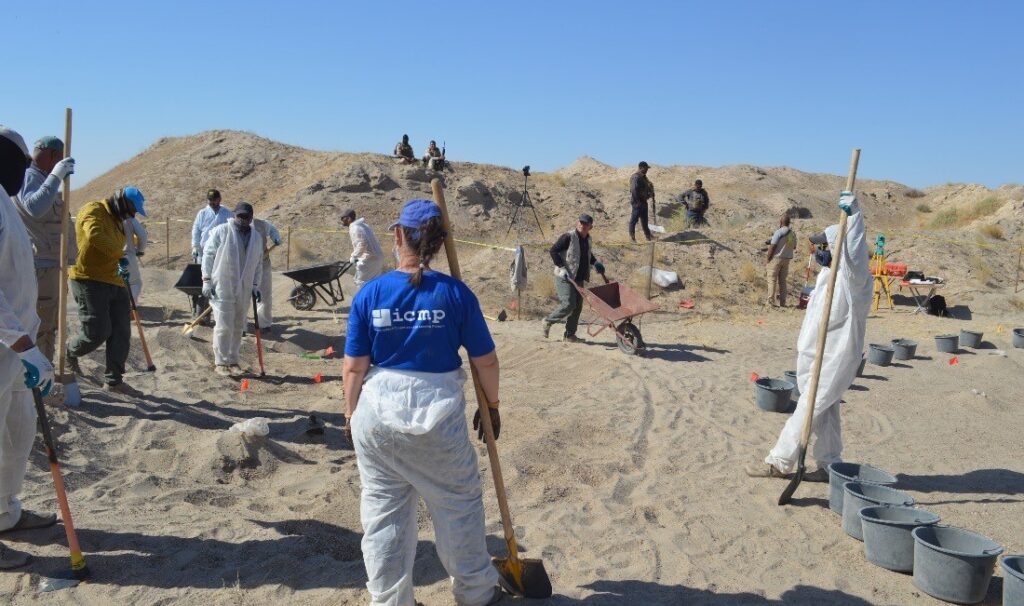
ICMP’s strategy focuses on developing a centrally coordinated approach through a central mechanism; strengthening the capacity of CSOs and building bridges with government authorities; and advancing Iraq’s legal framework, incorporating international legal standards, including ensuring that the specific rights of women survivors of missing persons are secured. It is supporting the Directorate for Protection and Mass Graves Affairs (MGD) of the Martyrs’ Foundation, the Medico-Legal Directorate (MLD) of the Ministry of Health, and the Kurdistan Ministry of Martyrs and Anfal Affairs (MoMAA), by conducting forensic archaeological assessments, anthropological examinations and human identification work, supporting data collection campaigns, providing data systems technologies; delivering dedicated training programs, and other activities.