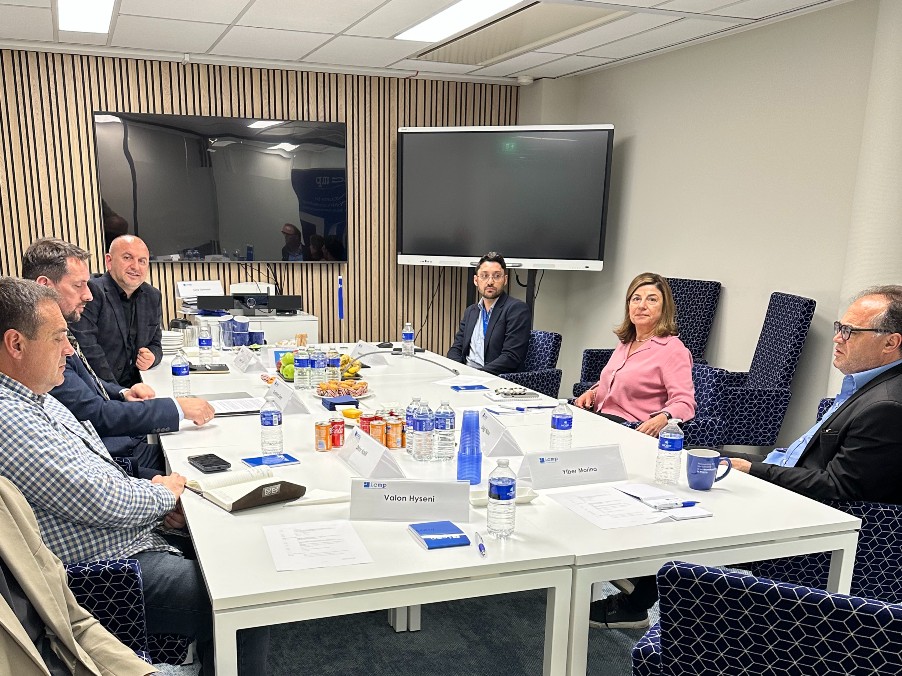
[:en] 19 March 2008: During his visit to Bosnia and Herzegovina, the United Kingdom Minister for Europe, Mr. Jim Murphy visited the DNA Laboratory and offices of the International Commission on Missing Persons (ICMP) in Sarajevo today.
Accompanied by ICMP’s Chief Operating Officer, Mr. Adam Boys, and the British Ambassador to Bosnia and Herzegovina, H.E. Mr. Matthew Rycroft, the Minister toured the laboratory in Sarajevo where ICMP performs DNA extraction and genetic profiling of samples from mortal remains and of blood samples from surviving relatives.
“It is clear that ICMP’s DNA-led identification system is a powerful tool to enable family members of the missing to achieve a sense of closure as well as contributing to overall reconciliation and stability in this region. I am fascinated and impressed by ICMP’s professional approach to resolving this important issue. The expertise that has been developed by ICMP here is of great use and value not only to this country and to the region, but also to all countries where there has been catastrophic loss of live as a result of war or natural disaster”, said Mr. Murphy and added “I will never forget what I’ve seen today”.
“It is our main goal to end the anguish and uncertainty of the thousands of families who still do not know what happened to their loved ones and achieving this would not be possible without the active involvement and financial support that the British and other governments have so generously given to resolve the fate of the missing”, stated Mr. Boys.
The United Kingdom has supported ICMP since year 2000 with grants that have focused on the exhumations’ process and developing Bosnia’s own capacity to address the missing persons issue at the level of the state.
In addition to its technical support in the identification process, ICMP is the co-founder of the Missing Persons Institute of BiH. ICMP contributes to transitional justice activities, provides legislative support and helps in the development of networks of civil society organizations which advocate for truth, justice, and for the rights of family members of missing persons.
Of the 40,000 persons missing following the cessation of conflicts there are still some 17,500 persons unaccounted for today in the former Yugoslavia, out of approximately 13,500 are missing from Bosnia and Herzegovina. The missing persons problem is therefore one of the main human rights issues facing BiH today. Since November 2001, ICMP has led the way in using DNA as the first step in the process of identification. ICMP has information from 85,853 relatives of 28,495 missing people and 25,458 bone samples taken from mass graves throughout the former Yugoslavia. By matching DNA from relatives’ blood with the DNA of victims ICMP has identified 13,381 missing individuals from the region and over 800 victims of the 2004 Asian tsunami.[:bs]
Britanski ministar za Evropu, Jim Murphy, posjetio je danas DNK laboratoriju i kancelariju Međunarodne komisije za nestale (ICMP) kao dio svoje posjete Bosni i Hercegovini.
U pratnji šefa operacija ICMP-a, Adama Boysa, i ambasadora Velike Britanije u Bosni i Hercegovini Matthewa Rycrofta, ministar je obišao ICMP-evu glavnu laboratoriju u Sarajevu gdje ICMP obavlja ekstrakciju DNK i genetsko profiliranje koštanih uzoraka sa posmrtnih ostataka i krvnih uzoraka živih članova porodica
„Jasno je da je ICMP-ev identifikacijski sistem moćno sredstvo koje omogućava da rođaci nestalih osoba dobiju osjećaj smiraja, a takođe doprinosi pomirenju i stabilnosti u ovom regionu. Fasciniran sam i impresioniran ICMP-evim profesionalnim pristupom rješavanju ovog važnog problema. Ekspertiza koju je ICMP ovdje razvio izuzetno je korisna i vrijedna ne samo za ovu zemlju i ovaj region, nego za sve zemlje koje dožive katastrofalne gubitke života kao rezultat rata ili prirodne nepogode”, izjavio je Murphy i dodao da nikada neće zaboraviti ono što je vidio danas.
„Naš glavni cilj je da okončamo agoniju i nespokoj hiljada porodica koje još uvijek ne znaju šta se desilo sa njihovim voljenim. Ostvarenje ovog cilja ne bi bilo moguće bez aktivnog angažmana i finansijske podrške koju je vlada Velike Britanije, zajedno sa drugim vladama, velikodušno pružala kako bi se riješila sudbina nestalih osoba”, izjavio je Boyse.
Velika Britanija podržava ICMP od 2000. godine donacijama za proces ekshumacija i za razvijanje sopstvenih kapaciteta Bosne i Hrecegovine koji će se baviti rješavanjem problema nestalih osoba na državnom nivou.
Pored pružanja tehničke pomoći, ICMP je i suosnivač Instituta za nestale osobe Bosne i Hercegovine. ICMP pruža doprinos aktivnostima uspostave pravde u tranzicijskom periodu, pruža pravnu podršku i pomaže razvoj mreža nevladinih organizacija koje se zalažu za istinu, pravdu i za prava porodica nestalih osoba.
Od 40.000 osoba koje su smatrane nestalim po okončanju sukoba, još oko 17.500 se vode kao nestale u bivšoj Jugoslaviji, od čega su 13.500 nestalih osoba iz Bosne i Hercegovine. Ova činjenica predstavlja jedan od najvećih problema ljudskih prava s kojim se Bosna i Hercegovina danas suočava. Od novembra 2001. godine ICMP koristi DNK analizu kao prvi korak u procesu identifikacije. ICMP ima informacije o 85.853 člana porodica nestalih koji tragaju za 28.495 svojih nestalih srodnika i posjeduje 25.458 koštanih uzoraka sakupljenih iz masovnih grobnica širom bivše Jugoslavije. Pronalaženjem podudarnosti između DNK žrtava i DNK iz krvi srodnika ICMP je identifikovao 13.381 nestalu osobu iz regije, i preko 800 žrtava azijskog tsunamija iz 2004. godine.
[:ar][:es]
During his visit to Bosnia and Herzegovina, the United Kingdom Minister for Europe, Mr. Jim Murphy visited the DNA Laboratory and offices of the International Commission on Missing Persons (ICMP) in Sarajevo today.
Accompanied by ICMP’s Chief Operating Officer, Mr. Adam Boys, and the British Ambassador to Bosnia and Herzegovina, H.E. Mr. Matthew Rycroft, the Minister toured the laboratory in Sarajevo where ICMP performs DNA extraction and genetic profiling of samples from mortal remains and of blood samples from surviving relatives.
“It is clear that ICMP’s DNA-led identification system is a powerful tool to enable family members of the missing to achieve a sense of closure as well as contributing to overall reconciliation and stability in this region. I am fascinated and impressed by ICMP’s professional approach to resolving this important issue. The expertise that has been developed by ICMP here is of great use and value not only to this country and to the region, but also to all countries where there has been catastrophic loss of live as a result of war or natural disaster”, said Mr. Murphy and added “I will never forget what I’ve seen today”.
“It is our main goal to end the anguish and uncertainty of the thousands of families who still do not know what happened to their loved ones and achieving this would not be possible without the active involvement and financial support that the British and other governments have so generously given to resolve the fate of the missing”, stated Mr. Boys.
The United Kingdom has supported ICMP since year 2000 with grants that have focused on the exhumations’ process and developing Bosnia’s own capacity to address the missing persons issue at the level of the state.
In addition to its technical support in the identification process, ICMP is the co-founder of the Missing Persons Institute of BiH. ICMP contributes to transitional justice activities, provides legislative support and helps in the development of networks of civil society organizations which advocate for truth, justice, and for the rights of family members of missing persons.
Of the 40,000 persons missing following the cessation of conflicts there are still some 17,500 persons unaccounted for today in the former Yugoslavia, out of approximately 13,500 are missing from Bosnia and Herzegovina. The missing persons problem is therefore one of the main human rights issues facing BiH today. Since November 2001, ICMP has led the way in using DNA as the first step in the process of identification. ICMP has information from 85,853 relatives of 28,495 missing people and 25,458 bone samples taken from mass graves throughout the former Yugoslavia. By matching DNA from relatives’ blood with the DNA of victims ICMP has identified 13,381 missing individuals from the region and over 800 victims of the 2004 Asian tsunami.
[:]