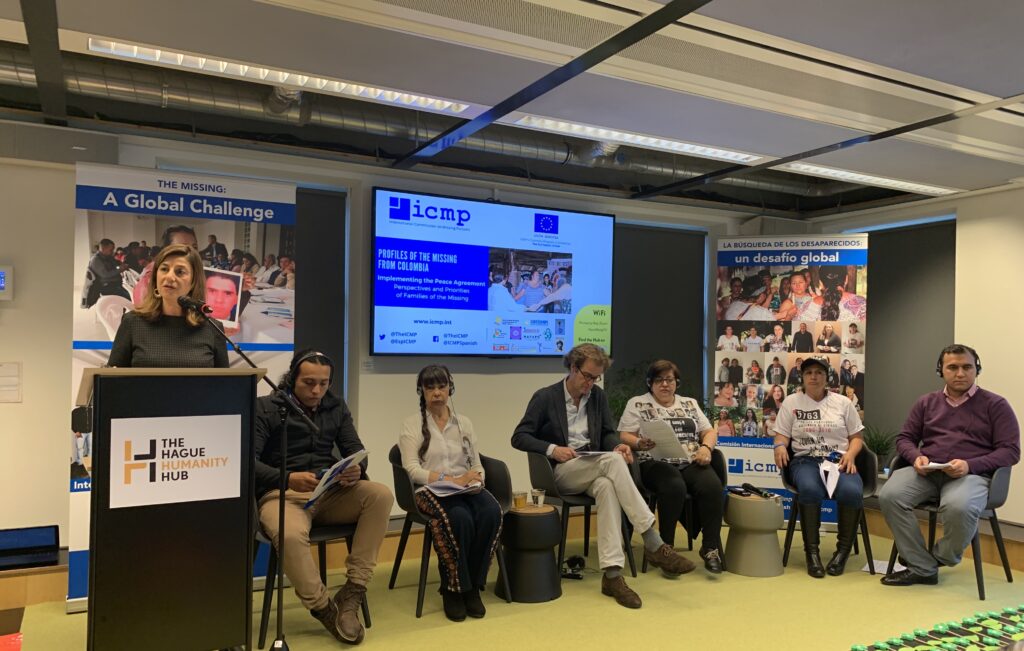
[:en]The Hague, 11 December 2019 – To mark this week’s celebration of International Human Rights Day, the International Commission on Missing Persons (ICMP) organized a “Profiles of the Missing” discussion in The Hague today on the effort now underway to address the huge legacy of missing persons in Colombia.
As many as 120,000 people are missing from five decades of conflict in Colombia, and all sectors of society have been affected. Disappearances have been perpetrated by state actors, paramilitary and guerrilla groups, and organized crime. Today’s “Profiles of the Missing” addressed the causes of the conflict, the impact of disappearances on society and the rule of law, and the central role that families of the missing can and must play in implementing key provisions of the 2016 Peace Agreement.
Fourteen family members of missing persons and representatives of civil society organizations working on this issue travelled from Colombia to participate in the discussion.
Opening the Profiles of the Missing event, ICMP Director-General Kathryne Bomberger recalled that this week’s commemoration of human rights highlights the fact that families of the missing have a fundamental right to truth, justice and reparation. “We recognize your courage,” she told the 14 Colombian representatives. “The work you are doing to account for the missing – despite the pain, despite the risk, despite the challenges – commands our gratitude and our respect.”
Pauline Diepenbroek, Deputy Director, Western Hemisphere Department, at the Foreign Ministry of the Kingdom of the Netherlands, welcomed the families to the Netherlands. “It is a privilege to be able to share this space with the families,” she said, and she stressed that the Netherlands is supporting the 2016 Peace Agreement in a number of ways, focusing on transitional justice, and she commended the work being done in Colombia by ICMP.
Ms. Semina Alekić, Chair of the Steering Board of the Regional Coordination of Families of the Missing from the Former Yugoslavia, described ICMP’s work in Bosnia, including helping families to defend their rights. “I would like to send a message of encouragement to Colombian families of the missing. We offer our experience and our knowledge and our support.”
Gloria Gómez of the Association of Families of Detainees/Disappeared (ASFADDES), and Yanneth Bautista of the Nydia Érika Bautista Foundation have been working with cases of forced disappearance for more than three decades. They stressed that the Peace Agreement has reactivated and made visible the discussion about the issue of the disappeared in Colombia. Thanks to the Agreement, institutional commitments have been generated, such as the creation of the Search Unit of Persons Listed as Disappeared. They noted that organizations working on the issue of the disappeared had experienced solidarity when they came together as part of the peace dialogues that preceded the final agreement.
Jacqueline Castillo Peña of the Mothers of victims of extrajudicial killings of Soacha spoke about the reality of extrajudicial executions in the country and the current status of peace implementation. “Cases were initially dealt with by the ordinary justice system and in this there was a lot of impunity, as the military hardly ever attended hearings,” she said. “Now that cases of extrajudicial executions are part of the Special Jurisdiction for Peace, they have had the opportunity to hear the military’s testimony.” Although she points out that progress has been limited because senior officers have not testified, she said some clarity had been achieved. She said the struggle will continue until “each soldier who gave the order for these murders is known”.
Emerson Rojas Rojas, of the Colombian Association of Military Victims of Kidnapping and Forced Disappearance spoke about the importance of the Integral System of Truth, Justice, Reparation and Non-Repetition, a transitional justice system created by the Agreement. Emerson said that for the system to work properly, “the State must commit itself to enforce the Agreement; the FARC must provide information on all kidnapped, disappeared and recruited minors; the victims must commit to participate in the system; and the international community must fulfill its commitment to oversee the process”.
Jhon Fredy León González, a former member of the Revolutionary Armed Forces of Colombia (FARC) who is now part of the Search Team of the new FARC political group, highlighted the role that the FARC is playing in the search for the disappeared. “From the day after the signing of the agreement we have been committed to the search,” he said. “We have currently documented more than 300 cases of disappearances of both civilians, members of the security forces, and members of the FARC and have turned them over to the Search Unit for them to begin their investigations.“
The discussion was moderated by Edwin Koopman, Latin American correspondent for the Dutch media outlets VPRO and Trouw.
ICMP is specifically mandated under the 2016 Peace Agreement between the Government and the largest guerrilla group, the FARC, to support the technical capacity of the Search Unit of Persons Listed as Missing and work to strengthen the capacity of civil society to participate in the efforts of the Search Unit. ICMP supports the participation of families in the missing persons process, and promotes their engagement in securing their rights to an effective investigation, truth, reparation and guarantees of non-repetition. ICMP’s Colombia program is funded by the European Union.
ICMP’s Profiles of the Missing is a public forum that brings together families of the disappeared to examine core elements of the missing persons issue, raise public awareness, make recommendations and demonstrate to policymakers that tackling this issue is central in efforts to support human security, conflict-prevention, peace building and justice. The participation of surviving relatives of the missing is central to the Profiles approach.
ICMP is a treaty-based international organization with Headquarters in The Hague, the Netherlands. Its mandate is to secure the cooperation of governments and others in locating missing persons from conflict, human rights abuses, disasters, organized crime, irregular migration and other causes and to assist them in doing so. It is the only international organization tasked exclusively to work on the issue of missing persons. [:es]La Haya, 11 de diciembre de 2019. Para celebrar esta semana el Día Internacional de los Derechos Humanos, la Comisión Internacional sobre Personas Desaparecidas (ICMP) organizó hoy en La Haya el foro: “Perfiles de los Desaparecidos”, sobre el esfuerzo que se está llevando a cabo para abordar el enorme legado de personas desaparecidas en Colombia.
120.000 personas están desaparecidas en cinco décadas de conflicto en Colombia, y todos los sectores de la sociedad se han visto afectados. Las desapariciones han sido perpetradas por actores estatales, grupos paramilitares y guerrilleros, y por el crimen organizado. Los “Perfiles de los desaparecidos” aborda las causas del conflicto, el impacto de las desapariciones en la sociedad y el Estado de derecho, y el papel central que las familias de los desaparecidos pueden y deben desempeñar en la aplicación de las disposiciones clave del Acuerdo de Paz de 2016.
Catorce familiares de personas desaparecidas y representantes de organizaciones de la sociedad civil que trabajan en este tema viajaron desde Colombia para participar en el debate.
En la apertura de los “Perfiles de los Desaparecidos” la Directora General de ICMP, Kathryne Bomberger, recordó que la conmemoración de los derechos humanos de esta semana pone de relieve el hecho de que las familias de los desaparecidos tienen un derecho fundamental a la verdad, la justicia y la reparación. “Reconocemos su valentía”, dijo a los 14 representantes colombianos. “El trabajo que están haciendo para dar cuenta de los desaparecidos – a pesar del dolor, a pesar del riesgo, a pesar de los desafíos – merece nuestra gratitud y nuestro respeto.”
Pauline Diepenbroek, Directora Adjunta, Departamento del Hemisferio Occidental, Ministerio de Relaciones Exteriores del Reino de los Países Bajos, dio la bienvenida a las familias a los Países Bajos. “Es un privilegio poder compartir este espacio con las familias”, dijo, y destacó que Holanda está apoyando el Acuerdo de Paz de 2016 de varias maneras, centrándose en la justicia transicional, y elogió el trabajo que está realizando la ICMP en Colombia.
La Sra. Semina Alekić, Presidenta de la Junta Directiva de la Coordinación Regional de las Familias de los Desaparecidos de la ex Yugoslavia, describió el trabajo de ICMP en Bosnia, incluyendo la ayuda a las familias para defender sus derechos. “Me gustaría enviar un mensaje de aliento a las familias colombianas de los desaparecidos. Ofrecemos nuestra experiencia, nuestros conocimientos y nuestro apoyo”.
Gloria Gómez, de la Asociación de Familiares de Detenidos/Desaparecidos (ASFADDES), y Yanneth Bautista, de la Fundación Nydia Érika Bautista, han estado trabajando con casos de desapariciones forzadas durante más de tres décadas. Destacaron que el Acuerdo de Paz ha reactivado y hecho visible la discusión sobre el tema de los desaparecidos en Colombia. Gracias al Acuerdo se han generado compromisos institucionales, como la creación de la Unidad de Búsqueda de Personas dadas por Desaparecidas. Señalaron que las organizaciones que trabajan en el tema de los desaparecidos habían experimentado solidaridad cuando se reunieron como parte de los diálogos de paz que precedieron al acuerdo final.
Jacqueline Castillo Peña, de las Madres de las Víctimas de Falsos Positivos de Soacha, MAFAPO, habló sobre la realidad de las ejecuciones extrajudiciales en el país y el estado actual de la aplicación de la paz. “En un principio, los casos eran tratados por la justicia ordinaria, y en ello había mucha impunidad, ya que los militares casi nunca asistían a las audiencias”, dijo. “Ahora que los casos de ejecuciones extrajudiciales forman parte de la Jurisdicción Especial para la Paz, han tenido la oportunidad de escuchar el testimonio de los militares.” Aunque señala que el progreso ha sido limitado debido a que los oficiales superiores no han testificado, dijo que se ha logrado cierta claridad. Dijo que la lucha continuará hasta que “cada superior que dio la orden de estos asesinatos sea conocido”.
Emerson Rojas Rojas Rojas, de la Asociación Colombiana de Militares Víctimas de Secuestro y Desaparición Forzada – ACOMIDES se refirió a la importancia del Sistema Integral de Verdad, Justicia, Reparación y No Repetición, un sistema de justicia transicional creado por el Acuerdo. Emerson dijo que para que el sistema funcione adecuadamente, “el Estado debe comprometerse a hacer cumplir el Acuerdo; las FARC deben proporcionar información sobre todos los menores secuestrados, desaparecidos y reclutados; las víctimas deben comprometerse a participar en el sistema; y la comunidad internacional debe cumplir con su compromiso de supervisar el proceso”.
Jhon Fredy León González, ex miembro de las Fuerzas Armadas Revolucionarias de Colombia (FARC) que ahora forma parte del Equipo de Búsqueda del nuevo grupo político de las FARC, destacó el papel que las FARC están jugando en la búsqueda de los desaparecidos. “Desde el día después de la firma del acuerdo hemos estado comprometidos con la búsqueda”, dijo. “Actualmente hemos documentado más de 300 casos de desapariciones de civiles, miembros de las fuerzas de seguridad y miembros de las FARC y los hemos entregado a la Unidad de Búsqueda para que inicien sus investigaciones”.
La discusión fue moderada por Edwin Koopman, corresponsal latinoamericano de los medios de comunicación holandeses VPRO y Trouw.
El Acuerdo de Paz firmado en 2016 entre el Gobierno colombiano y el grupo guerrillero más grande del país: las FARC, estableció que la Comisión Internacional sobre Personas Desaparecidas tiene el mandato específico de apoyar la capacidad técnica de la Unidad de Búsqueda de Personas dadas por Desaparecidas y trabajar para fortalecer la capacidad de la sociedad civil para participar en los esfuerzos de la Unidad de Búsqueda. ICMP apoya la participación de las familias en el esfuerzo por rendir cuentas de sus familiares, y promueve su compromiso para asegurar sus derechos a una investigación efectiva, verdad, reparación y garantías de no repetición. El programa de ICMP en Colombia está financiado por la Unión Europea.
Los “Perfiles de los Desaparecidos” de ICMP es un foro público que reúne a las familias de los desaparecidos para examinar los elementos centrales de la cuestión de las personas desaparecidas, sensibilizar a la opinión pública, hacer recomendaciones y demostrar a los responsables de la formulación de políticas que abordar esta cuestión es fundamental en los esfuerzos para apoyar la seguridad humana, la prevención de conflictos, la construcción de la paz y la justicia. La participación de los familiares supervivientes de los desaparecidos es fundamental para el enfoque de este foro.
ICMP es una organización internacional basada en tratados con sede en La Haya, Países Bajos. Su mandato es asegurar la cooperación de los gobiernos y otros para localizar a las personas desaparecidas en conflictos, abusos de los derechos humanos, desastres, crimen organizado, migración irregular y otras causas y apoyarlos para conseguirlo. Es la única organización internacional que trabaja exclusivamente en el tema de las personas desaparecidas.
[:]