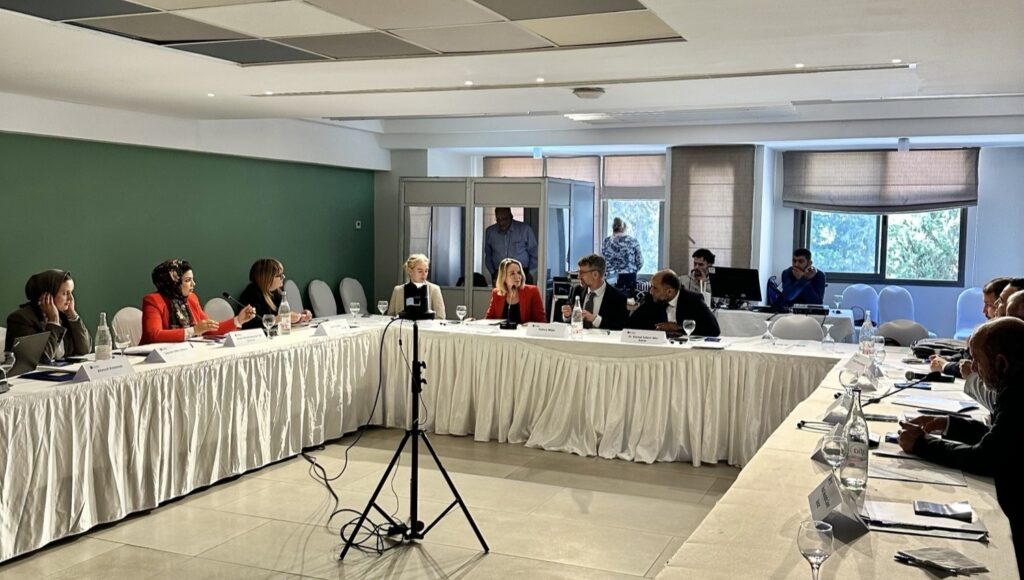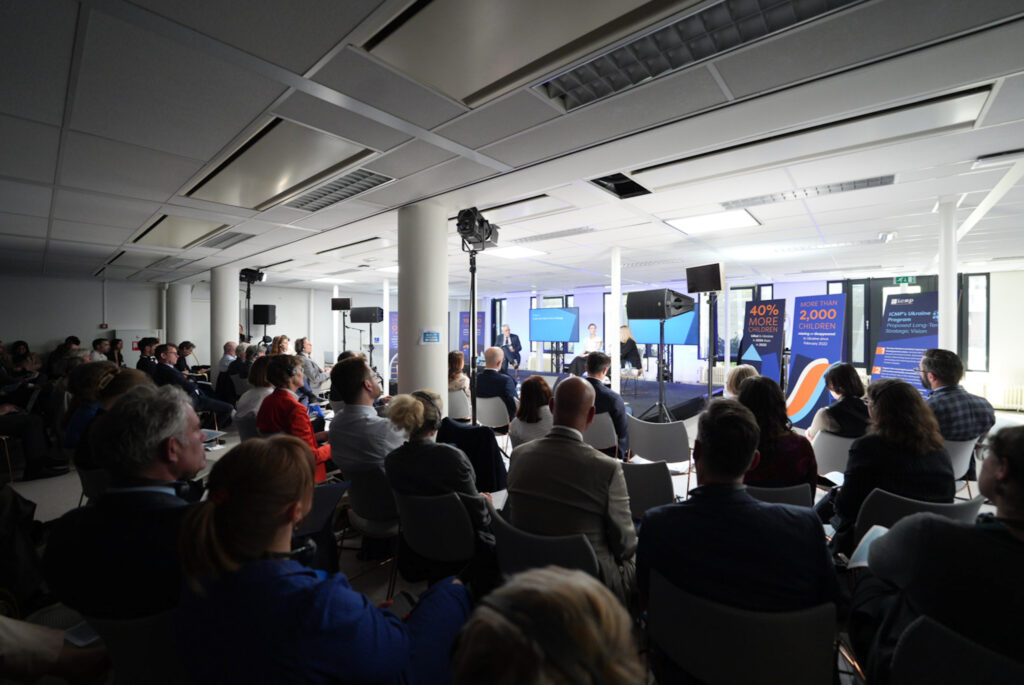
The Hague, 19 June 2024: Government and civil society representatives from Ukraine, as well as foreign experts and representatives of the international community, participated at a roundtable at the Headquarters of the International Commission on Missing Persons (ICMP) in The Hague today, focused on enhancing Ukraine’s strategic vision to locate tens of thousands of missing persons, including illegally deported children.
Her Majesty Queen Noor, an ICMP Commissioner since 2001, noted that at roundtables organized by ICMP in Kyiv at the end of May and in Warsaw last week there was broad consensus on the pivotal role a Central Database will play in assembling the wealth of missing persons data that is collected by different agencies. “There was also consensus on the need for constant communication with families of the missing,” she said, “and the urgent need for an Outreach Campaign to collect genetic data from tens of thousands of family members residing inside and outside Ukraine.”
Artur Dobroserdov, Ukraine’s Commissioner for Missing Persons, said the Unified Register of Persons Disappeared Under Special Circumstances currently lists 2,145 individuals who were under 18 at the time of their disappearance. “Reliable information about missing persons is diminishing over time,” he said. “Therefore, it is crucial that all the information collected from different sources is being recorded and stored properly. In the future, the primary sources may no longer exist or may be distorted, failing to reflect the true situation.”
Sara Huston, Professor at Northwestern University, Director of the Genetics and Justice Laboratory at Lurie Children’s Hospital of Chicago, and co-founder of DNA Bridge, an organization that works on reunifying families using DNA, noted that available technology can help to reunite families in the short term but also over a period of decades. “Used in partnership with civil society, infrastructure that aids families who are grieving the loss of loved ones can be adapted to reunify living family members,” she said, adding that there is a need for a global DNA database system to aid family reunifications.
Maksym Maksymov, Head of Projects at Bring Kids Back UA, an initiative of the President of Ukraine, said that “due to the scale of Russian atrocities against Ukrainian children, there will be plenty of work for the government, civil society and international partners for years to come.” He called for a coordinated international effort to exert pressure on the Russian government so that deported children are returned home.
Former Norwegian Foreign Minister Knut Vollebaek, who has been an ICMP Commissioner since 2013, and Chair of the organization since 2023, noted that said that in a DNA-led process, samples of blood or saliva are taken from relatives, and DNA extracted from these samples is compared with DNA taken from unidentified human remains or from living people who are unable to identify themselves “and, of course, many of the children who have been deported to Russia may come into this category.” He said the roundtable had produced clarity on “helping to develop the technical capacity of Ukrainian forensic and investigative personnel; supporting and enhancing the meaningful participation of civil society; strengthening intergovernmental and in-country cooperation and coordination among the relevant stakeholders; raising public awareness about the missing persons issue and the steps that are being taken to address it; and strengthening Ukraine’s institutional capacity and the legislative framework to account effectively for missing persons.”
Members of the ICMP Board of Commissioners participated in the Roundtable following the annual meeting of the Board yesterday. Commissioners also took part in a meeting this morning with representatives of states that are members or observers of ICMP’s Conference of States Parties. This was ahead of a Diplomatic Conference scheduled to be convened towards the end of 2024 at which the process of amending the ICMP Treaty in order to facilitate membership and funding is expected to be completed.
ICMP’s Ukraine Program is supported by the European Union and the governments of Canada, Germany, Norway, and the United States.
About ICMP
ICMP is a treaty-based intergovernmental organization with Headquarters in The Hague, the Netherlands. Its mandate is to secure the co-operation of governments and other authorities in locating persons missing as a result of conflicts, human rights abuses, disasters, organized violence and other causes and to assist them in doing so.