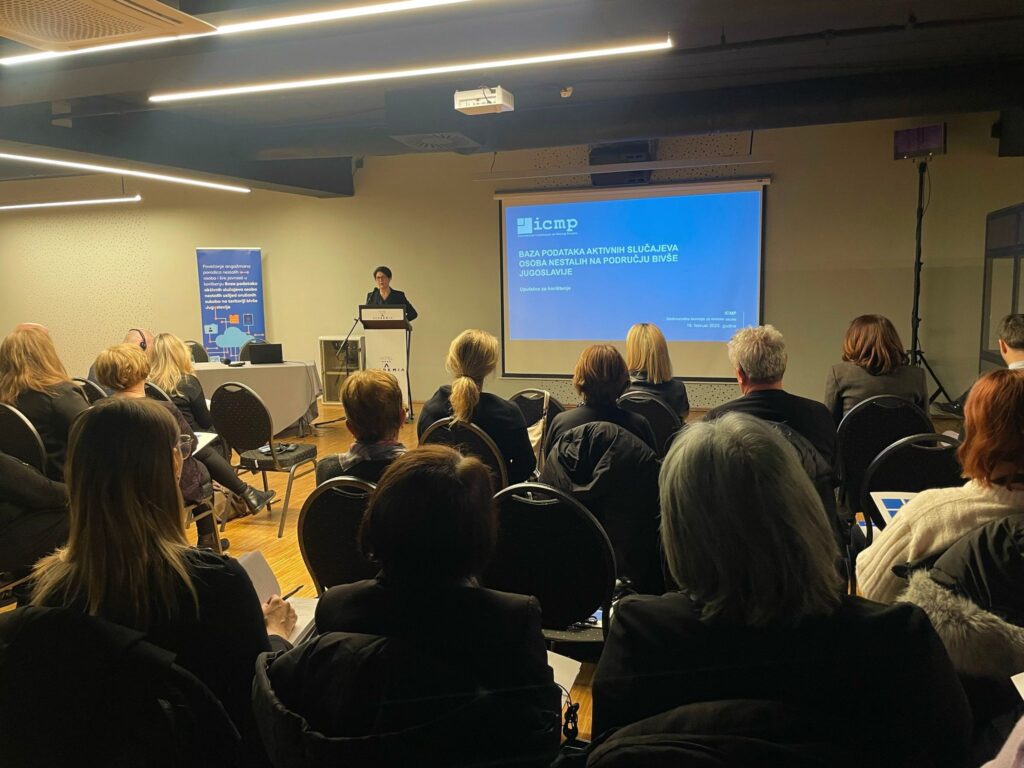
Zagreb, 20 February 2025 – The International Commission on Missing Persons (ICMP), with support of the United Kingdom, and in cooperation with the Union of Associations of Families of Detained and Missing Croatian Veterans and the Directorate for Detained and Missing Persons of the Ministry of Croatian Veterans, has presented the online version of the Regional Database of Active Missing Persons Cases from the Armed Conflicts in the Former Yugoslavia (the Regional Database) and its functionalities to families of missing persons and the public in Croatia.
The interactive database provides up-to-date records on missing persons cases and is available to the public It also enables families of the missing to access existing records and supply new information that could contribute to the resolution of active missing persons cases.
Samira Krehić, Deputy Head of the Western Balkans Program at ICMP, emphasized that, “The Regional Database is a crucial tool for harmonizing and exchanging data in real time, among relevant national institutions and with the public. It promotes transparency and accuracy in investigating missing persons cases, contributing to truth and justice. Its accessibility empowers families of the missing to actively participate in the process of accounting for their loved ones and provide credible, verified information on active cases in the region.”
ICMP and the Missing Persons Group (MPG), which comprises domestic institutions responsible for missing persons issues from Bosnia and Herzegovina, Croatia, Kosovo, Montenegro, and Serbia, created this database in the context of Berlin Process. Its public version is user friendly and searchable by name, father’s name, surname or reported place of disappearance.
Simon Thomas, British Ambassador to Croatia said: “The UK is a longstanding partner of ICMP in its important work and a strong international ally to the countries of the former Yugoslavia, promoting security, stability, and prosperity across the region. This includes a commitment to resolving the cases of over 11,000 people still missing following the conflicts and emphasizing the right of all families of the missing to truth, justice, and reparations”.
At the end of the conflict in the Former Yugoslavia, more than 40,000 persons were recorded as missing and today over 75 percent have been accounted for. Members of the MPG, with ICMP’s assistance, created official records on missing persons comprising direct reports by relatives of the missing or from cases documented by national institutions, NGOs, or international organizations involved in data collection.
The complexities of the conflicts presented significant challenges in maintaining accurate records. Many individuals went missing in areas other than their place of residence, and families of the missing were often displaced across borders, resulting in reports being filed in multiple countries. To address these challenges and improve investigations, it was essential to consolidate, harmonize, and verify records across borders. Since its creation, the Regional Database represents a key tool in data exchange between the relevant domestic institutions, data harmonization and consolidation of records of missing persons from the conflicts of the 1990s. By unifying data from Bosnia and Herzegovina, Croatia, Kosovo, Montenegro, and Serbia, the database addresses challenges such as cross-border disappearances and data inconsistencies.
Ljiljana Alvir, President of the Union of Associations of Families of Detained and Missing Croatian Veterans said: “Support for the process of resolving the issue of missing persons from the former Yugoslavia is extremely important because, without the cooperation of institutions and states, it is impossible to uncover the full truth about the missing. Since disappearances in one country are linked to areas in other countries, it is necessary to enhance this cooperation for the benefit of all families of the missing”.
The Database exemplifies how post-conflict societies can unite in the pursuit of a common goal, ensuring that the issue of missing persons remains a human rights priority and is not politicized to undermine peace and stability.
Christian Hellbach, Ambassador of Germany to Croatia said: “The resolution of missing persons cases is primarily a human rights cause, but it is also in Europe’s strategic interest, as it addresses a key issue hindering regional cooperation and stability in the Western Balkans. Resolving these cases is also essential for the region’s progress toward European integration. I have known ICMP for many years and have witnessed its work in Serbia, Colombia, Bosnia and Herzegovina, and even Chile. I deeply admire its efforts, and it is crucial to continue supporting its mission.”
The development of the Database was financially supported by the United Kingdom Government and the Federal Government of Germany.
Since its establishment, ICMP has played a crucial role in helping the authorities in the region to locate and identify more than 75 percent of more than 40,000 individuals reported missing from the conflicts. Through forensic expertise, data consolidation, and continuous engagement with families, ICMP has set global standards for addressing missing persons cases.
To access the Database, please follow the link.
More information about the work of the Missing Persons Group is available in this booklet.
About ICMP
ICMP is a treaty-based intergovernmental organization with Headquarters in The Hague. Its mandate is to secure the cooperation of governments and others in locating and identifying missing persons from conflict, human rights abuses, disasters, organized crime, irregular migration, and other causes and to assist them in doing so.