Hanoi, Vietnam, 28 July 2026 – The International Commission on Missing Persons (ICMP) joined the people and Government of Vietnam in commemorating Martyrs’ Day, honoring those who lost their lives during decades of conflict and recognizing the enduring uncertainty of the families who continue to seek answers about their missing loved ones.
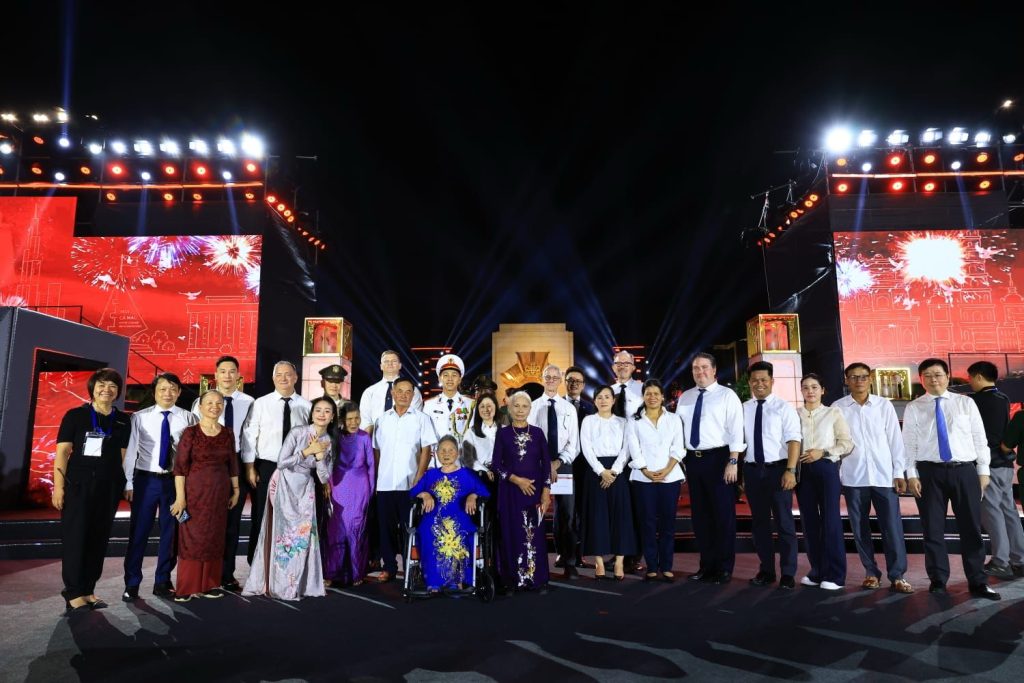
Representing ICMP at the nationally televised commemoration ceremony in Hanoi were ICMP Commissioner Thao Griffiths; Ambassador (ret.) Marc Knapper, former United States Ambassador to Vietnam and newly appointed member of the ICMP Panel of Experts; Chau Nguyen, ICMP Program Manager for Vietnam; and Tom Parsons, ICMP Senior Scientific Advisor. The event, held at the Fallen Soldiers Memorial adjacent to the Ho Chi Minh Mausoleum, was attended by General Secretary To Lam, members of the Politburo, and other senior government officials.
On behalf of ICMP, Commissioner Griffiths and Ambassador (ret) Knapper paid tribute to Vietnam’s fallen and to the hundreds of thousands of men and women who remain unaccounted for more than half a century after the end of the war.
“Martyrs’ Day is a powerful reminder that the consequences of conflict do not end when the fighting stops,” said ICMP Commissioner Thao Griffiths. “For many Vietnamese families, the search for truth and answers continues across generations. ICMP is honored to support Vietnam’s efforts to account for the missing and to help ensure that families can finally learn the fate of their loved ones.”
Vietnam faces one of the world’s largest unresolved missing persons challenges. Approximately 200,000 Vietnamese personnel remain unaccounted for, while an estimated 300,000 sets of human remains have yet to be identified. More than 50 years after the war, tropical conditions have significantly degraded skeletal remains, and many close relatives who could provide DNA reference samples are no longer living.
Since 2020, ICMP has partnered with the Center for DNA Identification (CDI), Institute of Biotechnology (IB) of the Vietnam Academy of Science and Technology (VAST), and institutions supporting the Vietnam Wartime Accounting Initiative (VWAI) to strengthen Vietnam’s capacity to account for missing persons through the application of advanced DNA technologies and internationally recognized forensic standards.
The partnership has focused on scientific collaboration, laboratory modernization, technology transfer, quality management systems, forensic archaeology and anthropology, secure data management, and training for Vietnamese specialists. The objective is to support the development of a sustainable, nationally owned system capable of operating at scale and independently over the long term.
Working together, CDI-IB-VAST and ICMP, achieved a significant scientific breakthrough in the application of Next Generation Sequencing (NGS) and advanced nuclear DNA analysis. By examining thousands of Single Nucleotide Polymorphism (SNP) markers simultaneously, ICMP and its Vietnamese partners have demonstrated the ability to establish kinship relationships using distant relatives, including third- and fourth-degree family members.
Validation studies undertaken as part of this cooperation have shown that approximately 70 percent of highly degraded skeletal remains can generate DNA profiles suitable for first-degree kinship analysis, while a substantial proportion can support analysis involving more distant relatives. In some cases, DNA profiles containing more than 5,000 SNP markers have enabled comparisons with relatives as distant as great-great-grandchildren.
These advances are now moving from research into operational implementation. Current pilot projects involving approximately 1,000 unidentified graves and more than 2,000 family reference samples are helping demonstrate the feasibility of a future nationwide DNA-led identification program.
“Vietnam’s dedication to account for its missing personnel has been remarkable and inspiring,” Ambassador (ret) Marc Knapper said. “The work Vietnam and its leadership are undertaking today reflects our shared commitment to science, international cooperation, and, most importantly, to the families who have waited decades for answers. ICMP is proud to contribute to this effort with the support of the U.S. Department of State through the Vietnam Wartime Accounting Initiative and in partnership with Vietnamese institutions that are leading this important work.”
As Vietnam commemorates Martyrs’ Day, ICMP reaffirms its support for all efforts aimed at ensuring that those who remain missing are found and that future generations inherit the knowledge that every effort was made to restore the identities of the missing and provide answers to their families. Together with its Vietnamese partners, and with the longstanding support of the U.S. Department of State through the Vietnam Wartime Accounting Initiative, ICMP remains committed to helping Vietnam build a sustainable and nationally owned system to account for the missing.
About ICMP
The International Commission on Missing Persons (ICMP) is a treaty-based intergovernmental organization headquartered in The Hague, the Netherlands. Established in 1996 at the initiative of the G7 Summit, ICMP is mandated to ensure the cooperation of governments and others in locating missing persons resulting from conflict, human rights violations, disasters, organized crime, migration, and other causes. Over nearly three decades, ICMP has supported more than 40 countries in developing internationally recognized systems for accounting for missing persons and has pioneered one of the world’s most advanced large-scale DNA identification capabilities.
About VWAI
The Vietnam Wartime Accounting Initiative is a U.S. government supported effort to help Vietnam find and identify Vietnamese personnel killed or missing from the Vietnam War.
VWAI is comprised of multiple lines of effort, including providing training and equipment so Vietnam can expand its use of DNA analysis in its identification efforts; training and use of archival research to locate prospective graves; support for veteran exchanges; facilitate public-private partnerships to bring in new technologies and resources to expand and support Vietnamese government led efforts. ICMP is one of the VWAI implementers.