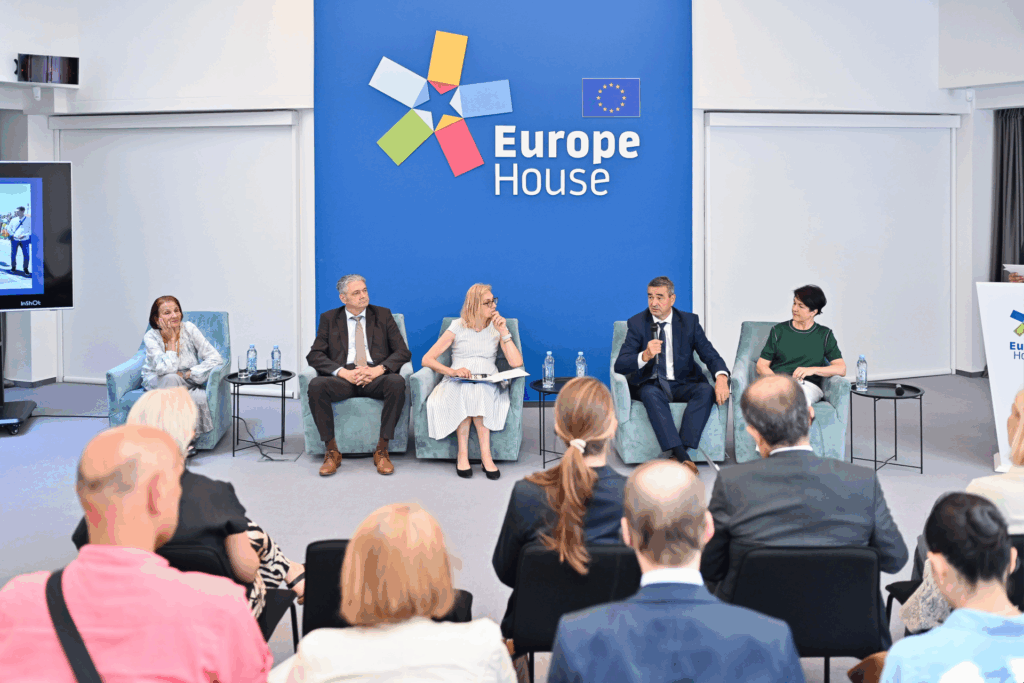
Sarajevo, 30 June 2025 – The International Commission on Missing Persons (ICMP), together with the European Union and the Embassy of Sweden, today presented key results over the last five years to further strengthen Bosnia and Herzegovina’s capacity to locate missing persons from the conflict of the 1990s. The presentation was followed by a panel discussion with institutional and civil society stakeholders on the future of the process.
To help Bosnia and Herzegovina resolve the fate of missing persons, ICMP has implemented a broad range of activities focused on capacity building, technical support in the fields of forensic anthropology, archaeology, and DNA analysis, and empowering families of the missing.
In the area of institutional strengthening, ICMP has conducted comprehensive training for laboratory personnel of the Agency for Forensic Examinations and Expertise (AFIV). In cooperation with AFIV, it has supported the preparation of draft standard operating procedures to guide future forensic work. The AFIV laboratory has been renovated, significantly enhancing the agency’s technical conditions and its capacity for effective forensic analysis.
To improve the management and analysis of complex forensic and personal data, ICMP donated its Integrated Data Management System (iDMS) to the Missing Persons Institute (MPI). This state-of-the-art software, developed in close collaboration with the MPI, is tailored to the requirements for maintaining the Central Missing Persons Registry and supports the secure handling of large volumes of sensitive data. Within the iDMS, ICMP developed the NNDMS module, which consolidates data on unidentified remains stored in mortuaries across Bosnia and Herzegovina. This provides MPI investigators with real-time access to the status of unidentified cases and the ability to update case information as needed. ICMP has also delivered training to MPI staff to ensure the effective use and long-term sustainability of these systems.
ICMP has provided forensic archeological and anthropological support to BIH in response to 450 official requests from the Prosecutor’s Office of Bosnia and Herzegovina and the MPI for assistance in locating, and recovering human remains from mass and clandestine gravesites. In addition, ICMP has issued expert opinions in response to 197 inquiries from the Prosecutor’s Office and the MPI related to the status or location of specific cases, supporting ongoing judicial and investigative processes.
To assist BIH with scientifically based identifications, ICMP has collected 55 genetic reference samples from family members of missing persons and has processed 1,125 post-mortem samples in its DNA laboratories. This has resulted in the submission of 810 DNA reports to the BIH authorities, which led to 243 new identifications and 498 reassociations of already identified persons.
In parallel with its institutional and technical work, ICMP has continued to support families of the missing and civil society organizations, with 33 grants totaling €78,000 awarded to family associations. These grants have helped to strengthen the advocacy efforts and organizational capacities of family associations working to uphold the rights of families and ensure their active participation in the missing persons process.
As part of its efforts to help BIH strengthen regional cooperation and cross-border missing persons cases, ICMP continues to support the work of the Missing Persons Group (MPG), a regional mechanism that brings together representatives from Bosnia and Herzegovina, Croatia, Kosovo, Montenegro, and Serbia. This includes assistance with reports and presentations in the context of the Berlin Process, cross-border missing persons cases, and regular meetings of the Network of Families of the Missing from the regions of the former Yugoslavia, which ICMP supports. Regional coordination among families of the missing and governments has helped to build trust and cooperation and is an investment in peace and stability in the region
“Together with our partners, we have strengthened institutional capacities and delivered concrete results, but thousands of families are still waiting – for truth, for the identification and return of their loved ones, and for justice. ICMP will continue to help the authorities in BIH to account for the remaining missing persons, but a sustained commitment from domestic institutions is essential to maintain the momentum of the process,” said Samira Krehić, the Head of ICMP’s Western Balkans Program.
“Thousands of families in Bosnia and Herzegovina still wait for answers about their missing loved ones. Accounting for the missing is not just a humanitarian duty – it is a question of justice, truth, and reconciliation. The European Union has stood by the people of this country for more than two decades in this effort and will remain a committed partner as BIH takes full ownership of this process on its EU path. Together, we must ensure that every family’s right to know is respected and that facts prevail over denial and revisionism,” said Ambassador Luigi Soreca, Head of the EU Delegation to BIH and EU Special Representative.
“I am grateful to ICMP, the Movement of Mothers of Srebrenica and Žepa, the International Missing Persons Institute, the Agency for Forensic and Expert Examinations of BiH and the BiH Prosecutor’s office. The cooperation between public institutions, expert international organizations, and local civil society organizations is essential to safeguarding the progress achieved and paving the way for future efforts and to what still needs to be done,” Ambassador Helena Lagerlöf underlined.
During the panel discussion, participants reflected on past achievements and outlined the steps needed to ensure continued progress. Nikola Perišić, Chair of the Board of Directors of the Missing Persons Institute of BIH, highlighted the importance of long-term institutional and political support. Zorica Đurđević from the Prosecutor’s Office emphasized the importance of investigating war crimes in delivering justice to victims. Radiša Samardžija, Director of the Agency for Forensic Examination and Expertise, pointed to the value of international cooperation in upgrading forensic infrastructure and skills. Kada Hotić, representing the Movement of the Mothers of Srebrenica and Žepa Enclaves, called for renewed urgency, stressing that time is running out for many families still waiting for answers.
Since the end of the conflict, with ICMP assistance; and through the pioneering use of DNA; together with the active engagement of families of the missing, the authorities in Bosnia and Herzegovina have located more than 75 percent of the more than 30,000 people who went missing during the conflict.
About ICMP
ICMP is a treaty-based international organization with Headquarters in The Hague, the Netherlands. Its mandate is to secure the cooperation of governments and others in locating missing persons from conflict, human rights abuses, disasters, organized crime, irregular migration and other causes and to assist them in doing so.