Hanoi, December 2025 – A ceremony has been held in Hanoi to mark the first identification of missing Vietnamese soldiers made possible by a new DNA identification system that is being implemented jointly by the Vietnam Academy of Science and Technology (VAST) and the International Commission on Missing Persons (ICMP). This system was developed following a scientific breakthrough by ICMP and VAST scientists which allowed for DNA to be extracted from Vietnam’s highly degraded postmortem samples.
The number of persons missing in action from the wars that took place in Vietnam over 50 years ago, including the Vietnam-American war, are in the hundreds of thousands. These mortal remains can still be found in mass grave sites or in cemeteries across Vietnam, where they were buried without names.
Together with ICMP, VAST successfully developed and applied a modern DNA identification process using next-generation sequencing (NGS) and single nucleotide polymorphism (SNP) profiles to determine the identities of unidentified persons from highly degraded human remains, overcoming long-standing technical limitations of methods currently being used in Vietnam. The new technology, developed in collaboration with ICMP’s international experts and tailored to Vietnam’s conditions, optimizes DNA extraction and enables kinship analysis up to four or five generations, even for samples with poor quality DNA. It produced usable genetic data from nearly 90 percent of samples when piloted at Tra Linh cemetery and confirmed the identities of two soldiers. Beyond these initial results, it is expected that the new technology will play a key role in Vietnam’s broader effort to identify the human remains of thousands of missing persons, contributing to the national goals of human identification work by expanding its application nationwide, improving protocols, and supporting the overall mission of completing DNA analysis for tens of thousands of cases by 2030.
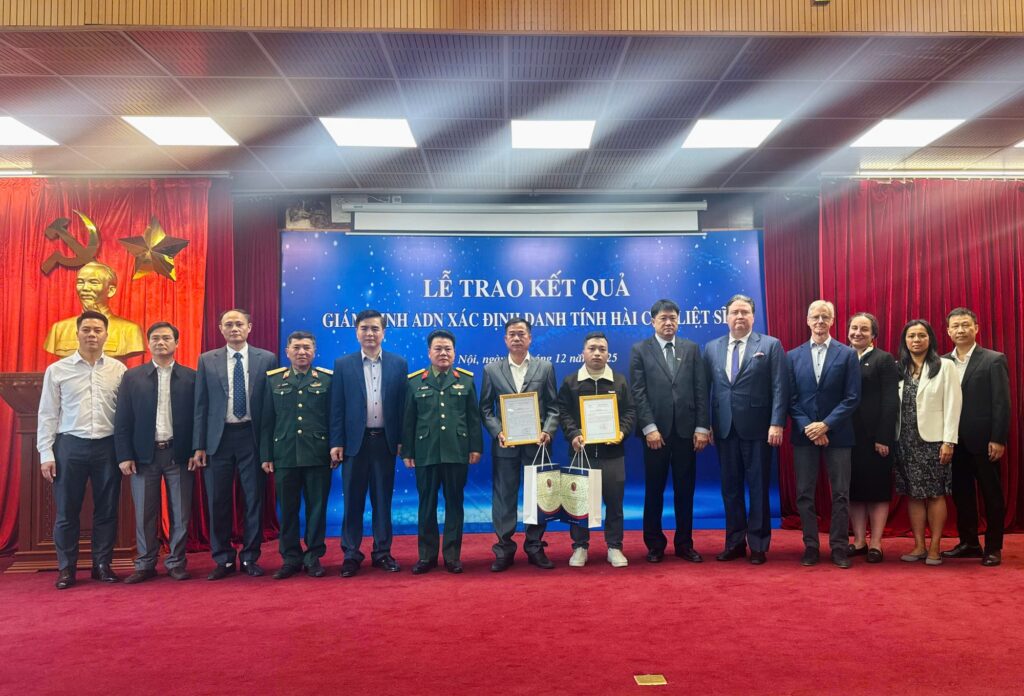
A ceremony to hand over the DNA identification results to the families of the two identified soldiers was organized on 11 December 2025 at VAST with the participation of all relevant stakeholders including representatives from the two soldiers’ families and related government agencies including the Ministry of National Defense, the Ministry of Home Affairs (including representatives from the two provinces where the soldiers’ families live), the Ministry of Foreign Affairs, the Ministry of Public Security, National Committee 515, the Military Forensic Institute, the National Forensic Institute, the Vietnam Office for Seeking Missing Persons, the Vietnam Martyrs’ Family Support Association, and research institutes under VAST, as well as ICMP representatives. US Ambassador Marc Knapper and his staff also attended the event and delivered remarks.
These identifications resulted from new techniques that can isolate extremely degraded DNA from bone samples that have been exposed to Vietnam’s tropical environment. This DNA is then matched with DNA taken from – even very distant – family members. Technical and software development, provision of equipment, training, and extensive testing have been conducted over the last two years under a partnership between VAST and ICMP, with support from the United States Government. Building on this initial milestone, the new system is expected eventually to enable thousands of additional identifications.
Since 2020, ICMP has been helping Vietnam to develop an effective, DNA-led missing persons process. In a pilot project launched in 2023, ICMP and the Institute of Biology’s (IB) Center for DNA Identification (CDI) jointly selected 100 bone samples, which were transported to ICMP’s laboratories in the Netherlands for testing. CDI staff also visited ICMP Headquarters in The Hague for multi-week training in advanced DNA extraction methods, and ICMP provided CDI with instruments to enable DNA extraction and DNA quality assessment.
A very high proportion of the bone samples processed under this project generated DNA profiles with sufficient power to enable identification when compared with distant relatives of the individual. This makes it possible to support the identification of decades-old remains, including those severely degraded by Vietnam’s climate, using reference samples from people living in Vietnam today. In some cases, this approach could enable the identification of remains belonging to ancestors as distant as great-great-grandparents.
Under this project, ICMP is supporting VAST in the development of advanced DNA extraction methods and the application of Next Generation Sequencing (NGS) technology to generate DNA profiles from highly degraded bone samples in Vietnam. This work is supported by data analysis tools, with the goal of establishing an automated system capable of processing large numbers of samples.
The cooperation between ICMP scientists and their Vietnamese counterparts contributes to the Vietnamese Government’s objective of identifying more than 300,000 sets of human remains from past conflicts.
About ICMP
ICMP is a treaty-based intergovernmental organization with Headquarters in The Hague, the Netherlands. Its mandate is to secure the cooperation of governments and others in locating missing persons from conflict, human rights abuses, disasters, organized crime, migration, and other causes, and to assist them in doing so.