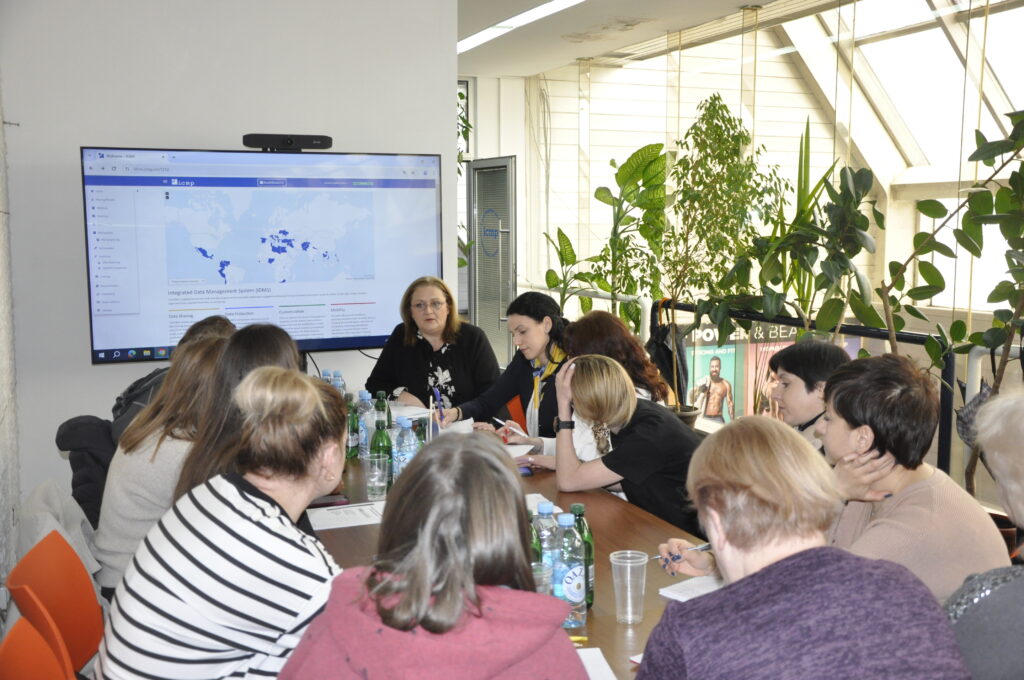
Sarajevo, 26 April 2024 – A group of family representatives and civil society activists from Ukraine have completed a week-long visit to Bosnia and Herzegovina (BIH) hosted by the International Commission on Missing Persons (ICMP). The visit is part of a program to support the development of an effective system to account for tens of thousands of people who are missing as a result of Russia’s invasion of Ukraine.
The study visit included meetings with officials from the BIH Missing Persons Institute, the Ministry for Human Rights and Refugees, and the War Crimes Prosecutor’s Office.
“ICMP is committed to helping Ukrainian civil society to build a sustainable process to locate all missing persons and investigate their disappearance and secure the rights of all families to truth, justice, and reparations,” said Matthew Holliday, ICMP Program Director Europe, noting that strategies that have succeeded in Bosnia and Herzegovina and the Western Balkans can serve as a model for a sustainable rule-of law-based process in Ukraine.
With ICMP assistance and through the pioneering use of DNA, the authorities in Bosnia and Herzegovina have been able to account for 75 percent of the 30,000 people who went missing during the conflict of the 1990s, a ratio that has not been equaled in any other post-conflict country.
Yulia Podaru, from the Group of Families of Military Servicemen of the 57th Brigade, said the visit had afforded an opportunity to “learn from families in Bosnia and Herzegovina about their experience and their quest of more than 28 years in searching for their missing. We will definitely use this experience in our country. We are impressed by how united they are, including the state institutions and civil society, and we believe that we can do the same in Ukraine.”
Olena Dobycha, Head of the Polygon 56 Berdyansk family association, said, “This visit has given us a great deal of information, especially about the experience of the families here and the work they have done. We were very happy to have had the opportunity to meet with them and hear their stories. We were also able to speak about our own pain and the loss we have experienced. We hope that they will find their loved ones and that we will do the same. We want every missing person to come home. We have seen the work that ICMP is doing in Western Balkans and we have learned about the use of DNA, which is important. We hope that our country will apply ICMP’s expertise.”
In July 2022 at the invitation of the Government of Ukraine, ICMP launched a comprehensive program based on a five-year strategy to help the authorities develop a sustainable missing persons process based on the rule of law. This includes providing access to high-volume, DNA-led identification capabilities, supporting steps to ensure that evidence collected, including evidence from mass and clandestine graves, is admissible in criminal trials, supporting laboratory operations, data collection, and mass grave investigations, providing Ukrainian institutions (including the police) and the Ukrainian public with access to secure and large-scale missing persons data processing, and supporting the active participation of civil society and families in the missing persons process.
The visit of Ukrainian family representatives and civil society activists is part of the project supported by the Government of Canada
About ICMP
ICMP is a treaty-based intergovernmental organization with Headquarters in The Hague, the Netherlands. Its mandate is to secure the cooperation of governments and others in locating and identifying missing persons from conflict, human rights abuses, disasters, organized crime, irregular migration and other causes and to assist them in doing so.