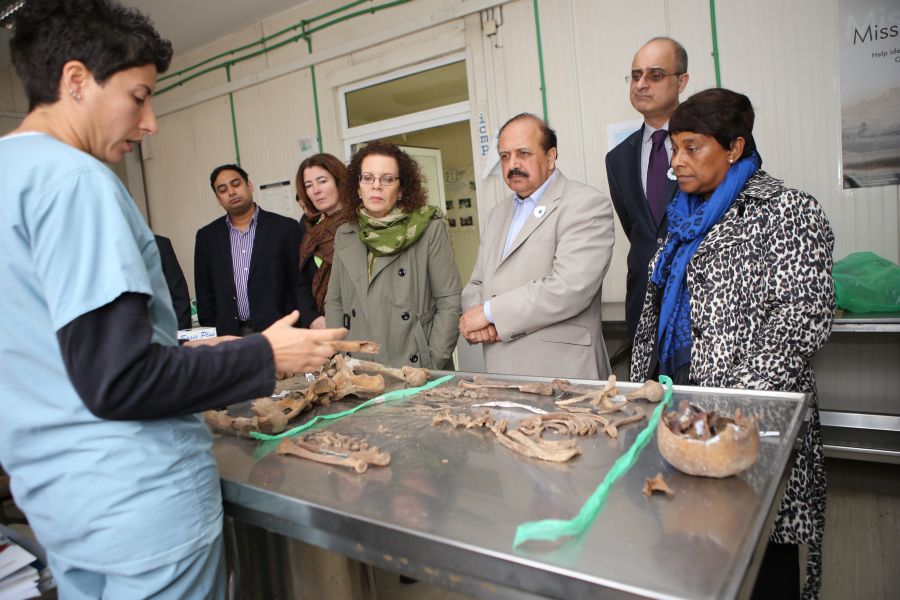
A group of dignitaries and academics from the UK visit ICMP

Share

[:en]16 April 2014: A delegation of members of the British House of Lords, human rights activists and public appointees paid a visit to the headquarters and identification facilities of the International Commission on Missing Persons (ICMP) in Sarajevo and Tuzla from Monday through Wednesday. The visit is organized by “Remembering Srebrenica”, a UK charitable initiative.

Members of the delegation include: Baroness Hussein-Ece, who in addition to her background in local government is the Liberal Democrats’ gender and equalities spokesperson; Baroness Manzoor, who was the former head of the Commission for Racial Equality, and served as the Legal Services Ombudsman for England and Wales; Baroness Williams who has worked extensively in government and on sub-regional governance issues; lecturer Dr Akil Awan; Dr Krishnan Manocha, Director of the Office of Public Affairs of the Bahá’í community; lawyer, historian and former journalist Dr Farooq Bajwa, and chief executive of Unitas Communications, Muddassar Ahmed.

The delegation also included Baroness Lawrence who was recently named the most powerful woman in the country in a list drawn up for BBC Woman’s Hour. Her eldest son, Stephen, a promising student hoping to study architecture, was murdered in a racist attack in London in 1993. The case gained notoriety in the UK for both the police’s mishandling of the enquiry, and Baroness Lawrence’s tireless fight to win justice for Stephen.

“Hearing and seeing is two different things. Being here in Bosnia and meeting the mothers really brought it home to me. The suffering that the mothers are still going through is unbearable to see. I found visiting the morgue where ICMP staff work most disturbing, and seeing the remains of the unidentified people. May they all rest in peace”, said Baroness Lawrence following the visit.

The delegation was headed by Mr. Iftikhar Awan, Convenor of the Cross-Government Working Group on Tackling Anti-Muslim Hatred.

During the visit, the delegation was introduced to ICMP’s work in Bosnia and Herzegovina, with a specific emphasis on those missing from Srebrenica 1995. The delegation was also introduced to activities that ICMP is carrying out to assist other governments around the world in dealing with the issue of missing persons. Following the visit to ICMP the delegation also toured the Potocari Memorial Center and cemetery where they talked with victim families.

This visit is a part of an initiative by the Chairman of the “Remembering Srebrenica” Dr. Waqar Azmi called “Lessons from Srebrenica” which aims to introduce groups of the UK opinion-makers to Bosnia and Herzegovina and the ICMP.

The ICMP is the only specialized international organization of its kind that addresses the issue of missing persons in all of its facets. The ICMP was created at a G-7 Summit in 1996 to work with governments
and others to help them locate and account for persons missing from the wars of the 1990’s in the former Yugoslavia.[:bs]

Uposlenik ICMP-a objašnjava proces antropološke obrade posmrtnih ostataka u Identifikacijskom projektu Podrinje u Tuzli

Delegacija članova Doma lordova britanskog parlamenta, aktivista za ljudska prava i javnih službenika obišla je sjedište i identifikacijske objekte Međunarodne komisije za nestale osobe (ICMP) u Sarajevu i Tuzli od ponedjeljka do srijede. Posjetu je organizovala britanska dobrotvorna inicijativa „Sjećanje na Srebrenicu“.

Delegaciju su sačinjavali baronesa Hussein-Ece, koja osim rada u lokalnoj vlasti obnaša funkciju portparola za rodna pitanja i pitanja jednakosti; baronesa Manzoor, bivša šefica Komisije za rasnu jednakost i ombudsman za Englesku i Vels; baronesa Williams koja intenzivno radi na pitanjima lokalne uprave; predavač dr. Akil Awan; dr. Krishnan Manocha, direktor ureda za odnose sa javnošću Baha’i zajednice; advokat, historičar i bivši novinar dr. Farooq Bajwa i izvršni direktor Unitas Communications, Muddassar Ahmed.

U delegaciji je bila i baronesa Lawrence koju je BBC-jev program „Ženin čas“ nedavno proglasio za najutjecajniju ženu Velike Britanije. Njen najstariji sin Stephen, uzoran student arhitekture, ubijen je u rasno motivisanom napadu u Londonu 1993. godine. Slučaj je stekao ogromnu popularnost u Velikoj Britaniji koliko zbog neprofesionalne policijske istrage toliko i zbog neumorne borbe baronese Lawrence da se izbori za pravdu za Stephena.

„Čuti i vidjeti su dvije različite stvari. To sam shvatila tek nakon što sam došla ovdje u Bosnu i susrela se sa majkama. Vidjeti nedaće kroz koje ove majke još uvijek prolaze je nepodnošljivo. Najteži dio posjete bila je posjeta mrtvačnici u kojoj rade ICMP-ovi ljudi gdje sam vidjela posmrtne ostatke neidentifikovanih osoba. Neka svi počivaju u miru“, izjavila je baronesa Lawrence nakon posjete.

Delegaciju je predvodio g. Iftikhar Awan, osnivač radne grupe u Velikoj Britaniji za rješavanje anti-muslimanske mržnje.

Tokom posjete, delegacija je informisana o ICMP-ovim aktivnostima u Bosni i Hercegovini, sa naglaskom na osobe nestale u Srebrenici 1995. godine, a upoznati su i sa aktivnostima koje ICMP ima sa vladama širom svijeta u rješavanju problema nestalih osoba. Nakon posjete ICMP-u, delegacija je obišla Memorijalni centar i groblje u Potočarima gdje su razgovarali sa porodicama žrtava.

Posjeta je dio programa koji vodi predsjednik inicijative „Sjećanje na Srebrenicu“, dr. Waqar Azmi, pod nazivom „Lekcije iz Srebrenice“, a ima cilj da tvorce javnog mnijenja u Velikoj Britaniji upozna sa Bosnom i Hercegovinom i ICMP-om.

ICMP je jedina specijalizirana međunarodna organizacija svoje vrste čiji rad obuhvata sve aspekte problema nestalih. ICMP je osnovan na samitu G-7 1996. godine u svrhu saradnje sa vladama i drugim relevantnim akterima u procesu pronalaska i identifikacije osoba nestalih u ratovima 1990-ih u bivšoj Jugoslaviji.
[:ar][:es][:]

Scroll to Top