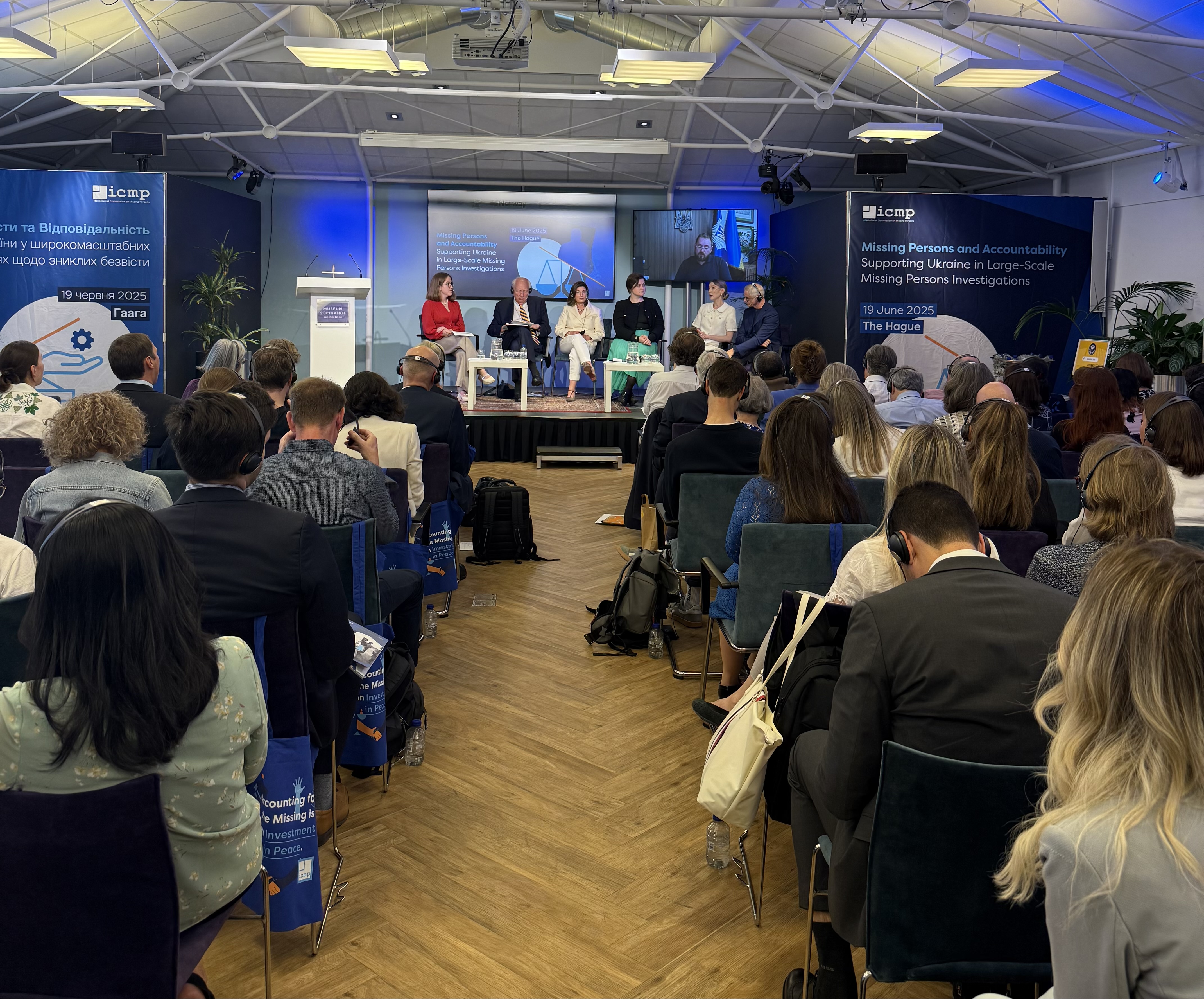
The Hague, 19 June 2025: Gathering evidence for future war crimes trials and upholding the rights of families of the missing are central pillars in the effort to account for more than 70,000 people missing from Ukraine, speakers stressed during a major conference organized by the International Commission on Missing Persons (ICMP) in The Hague today.
Ukrainian and international experts, government representatives, and human rights advocates participated in the discussion, which focused on supporting large-scale investigations into cases of persons missing as a result of the Russian invasion.
Artur Dobroserdov, Commissioner for Persons Missing Under Special Circumstances in the Ministry of Internal Affairs of Ukraine, stressed that since May 2023, Ukraine has maintained a Unified Register of Persons Missing in Special Circumstances, which currently contains information on more than 70,000 missing individuals. “The Register also includes a dedicated section on unidentified human remains, highlighting the scale and complexity of the issue. This centralized system is crucial for tracing missing persons, supporting investigations, and ensuring accountability.”
Mr Dobroserdov also noted that the process of identifying thousands of human remains “places a significant burden on forensic, law enforcement, and investigative institutions. Ukraine is actively working to expand the capacity of DNA laboratories and increase the number of genetic experts to meet this growing need. The introduction of the Integrated Data Management System (iDMS) provided by ICMP is expected to significantly improve data management and identification processes.”
ICMP Director-General Kathryne Bomberger noted that, “Now is the time to ensure that the human rights of survivors are protected and secured. This includes the right to justice, truth and reparations. This is fundamental to upholding the rule of law and the rules-based international order. Conducting judicial investigations is essential.”
Yuriy Bielousov, Head of the War Crimes Department in Ukraine’s Prosecutor-General’s Office, noted that the digitization – with ICMP support – of information collected by the Forensic Bureaus around the country has been a major step forward, “We, as prosecutors, need to have all data digitized . . . as there is a huge volume of data.” Like other speakers, he noted that a clear pattern of rights violations has been practiced by the Russian Federation, first in Chechnya and then in Georgia and now in Ukraine, where certain segments of society are targeted for enforced disappearance.
Dr. Kateryna Rashevska, a Legal Expert with the Regional Center for Human Rights, based in Kyiv, noted that “Ukraine must strengthen its domestic legal framework – by adopting legislation allowing investigations at the residence of relatives, rather than the place of the person’s disappearance, clarifying how enforced disappearance is qualified under our Criminal Code, and aligning definitions with international law. Ukraine must also enhance mutual legal assistance and international cooperation to enable effective evidence sharing and support victim searches. We must take a holistic approach – ensuring that every missing person is found and every perpetrator is held accountable. Because we do not merely have a political duty. We have a moral responsibility. Persistent impunity for violations of international humanitarian law fuels more abuses. If we do not stop it now, it will not stop at all.”
While acknowledging that “Ukraine has taken very significant practical steps to set in place the legislative, institutional and operational framework for an effective missing persons process,” Vrinda Grover, a member of the UN Independent Commission of Inquiry on Ukraine, noted that “Ordinary judicial and investigative authorities are seldom adequate to the task of addressing the problem of missing persons; part of the problem has to do with the immense case-load, part of it with lack of the necessary competencies (including sufficient and appropriate forensic competencies), but also with functional factors; judicial and related investigative authorities, are by orientation and design, more interested in the identification of perpetrators than on the resolution of the fate and whereabouts of the victims. The Commission has repeatedly emphasized a broad understanding of accountability including both judicial and non-judicial accountability, as an important facet of its commitment to a victim-centric approach.”
Former US Ambassador-at-Large for Global Criminal Justice Stephen J Rapp said “Often evidence gathered on battlefields is of enormous value to the military, but it almost never gets to criminal prosecutors. So, we are working with the National Police and their relationship with the military to bring thousands of documents within the evidence management system. Previously this information was siloed. (It is necessary) to be able to use that material for criminal justice, and to share information through a database as far as missing persons are concerned.”
Dr. Thomas Parsons, a former Head of Research at the US Armed Forces DNA Identification Laboratory (AFDIL) and the former Director of Science and Technology at ICMP, stressed that “Every large-scale missing persons context has both commonalities as well as unique features that must be clearly understood and carefully planned for. Experience from many contexts globally highlights the importance of centralized mechanisms and shared databases amenable to uniform processes independent of cased-by-case investigations.”
Oleksandra Romantsova, the Executive Director of Ukraine’s Center for Civil Liberties, noted that under the former Soviet system the public became accustomed to unexplained disappearances and, additionally, there was a legacy of insufficient confidence in law enforcement. “So, we really need to learn from the experience of countries in the Balkans, for example, or South America. The state is responsible for research and investigations: it’s a huge volume of work, especially during ongoing hostilities. We need the active role of those with the greatest stake in the process – families and society.”
Today’s roundtable was the fifth in a series organized by ICMP to examine issues related to missing persons cases and enforced disappearances as a result of the Russian invasion. The inaugural meeting in Kyiv in May 2024 focused on institutional and legislative frameworks. Subsequent meetings explored the role of forensic science and databases (Warsaw, June 2024), the abduction and deportation of Ukrainian children (The Hague, June 2024), and reparations for families of the missing (The Hague, co-organized with the Register of Damage for Ukraine, April 2025).
Across all the roundtables, participants have underscored the need for robust, rights-based investigations that ensure judicially admissible evidence, that enable reparations, and that lay the groundwork for long-term justice. As long as large numbers of missing are unaccounted for, any eventual political settlement will lack support and legitimacy. Accounting for the missing cannot be separated from bringing those responsible for their disappearance to justice.
Members of the ICMP Board of Commissioners participated in the Roundtable following the annual meeting of the Board, on 18 June. Commissioners also took part in a meeting this morning with representatives of states that are members or observers of ICMP’s Conference of States Parties. This followed a Diplomatic Conference convened in December 2024 at which the process of amending the ICMP Treaty in order to facilitate membership and funding was completed. The object of this morning’s meeting was to develop a system for supporting ICMP’s Investigation and Identification Standing Capacity.
ICMP’s Ukraine Program is supported by the governments of Canada, Germany, the Netherlands, Norway, and the United States.
About ICMP
ICMP is a treaty-based intergovernmental organization with Headquarters in The Hague, the Netherlands. Its mandate is to secure the co-operation of governments and other authorities in locating persons missing as a result of conflicts, human rights abuses, disasters, organized violence and other causes and to assist them in doing so.