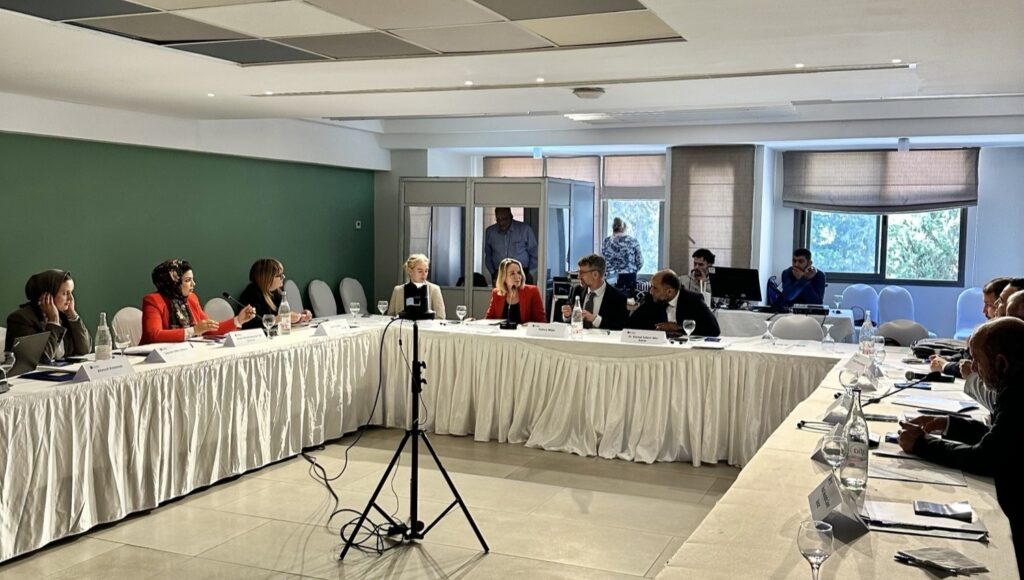
[:en]8 April 2009: A delegation of six Cypriot and Turkish Cypriot scientists working for the Committee on Missing Persons in Cyprus (CMP) attended a training course provided by the International Commission on Missing Persons (ICMP) in Bosnia Herzegovina. The purpose of the visit was to provide the bi-communal team of Cypriot scientists with the opportunity to broaden and enhance their existing forensic and anthropological skills.
Over three days from March 22nd – 25th, the group from the CMP’s Bi-Communal Forensic Team and Anthropological Laboratory became familiarized with the ICMP’s approach to current aspects of forensic anthropology, pathology and DNA identity testing. Presentations were made by ICMP experts whose work with DNA technology, an internationally recognised scientific method of human identification, has given their laboratory system a world-wide reputation.
The Committee on Missing Persons in Cyprus was established in April 1981 by agreement between the Greek Cypriot and Turkish Cypriot communities under the auspices of the UN, and is one of the only institutionalized, bi-communal committees in Cyprus, existing to establish the fate of persons reported missing in Cyprus’ inter-communal fighting in the 1960s as well as in the events of 1974 and afterwards.
“The training received at the ICMP is immensely useful for our scientists since the Commission is succeeding in dealing at all levels with an extremely large caseload of missing persons: the experience for our scientists is invaluable,” said Christophe Girod, the Third (UN) member of the CMP.
“The problem of missing persons is a universal one, and ICMP is delighted to enhance the work conducted by the bi-communal team of Cypriot forensic technical experts,” said ICMP’s Director-General, Ms. Kathryne Bomberger.
A total of 502 Turkish Cypriots and 1468 Greek Cypriots were officially reported as missing by both communities to the CMP, which does not attempt to establish the cause of death or attribute responsibility for the death of missing persons. To date the CMP has exhumed 252 burial sites, exhumed more than 510 individuals and identified 136 persons, whose remains have been returned to their families.
ICMP has one of the world’s highest throughput capacity for DNA identity testing. ICMP has been invited to provide assistance to: the Philippines (Typhoon Frank), Thailand (the 2004 SE Asian Tsunami), the United States (Hurricane Katrina), Chile, Colombia, CMP in Cyprus, Iraq, Kuwait and Norway (WWII), in addition to the work within the Western Balkans.[:bs]Delegacija od šest kiparskih naučnika iz Komiteta za nestale osobe Kipra (CMP) prisutvovali su obuci koju je Međunarodna komisija za nestale osobe (ICMP) za njih organizirala u Bosni i Hercegovini. Svrha ove posjete je bila da se kiparskim naučnicima iz obje kiparske zajednice pruži mogućnost da prošire i unaprijede svoje forenzičko i antropološko znanje.
U periodu između 22. i 25. marta, članovi CMP-evog mješovitog forenzičkog tima i antropološke laboratorije upoznali su se sa ICMP-evim pristupom forenzičkoj antropologiji, patologiji i identifikaciji putem DNK analize. Prezentacije su održali ICMP-evi eksperti čiji je rad sa DNK tehnologijom, međunarodno priznatom naučnom metodom za identifikaciju ljudi, priskrbio ICMP-evim laboratorijama svjetsku reputaciju.
Komitet za nestale osobe Kipra (CMP) osnovan je u aprilu 1981. godine sporazumom turske i grčke kiparske zajednice pod okriljem Ujedinjenih nacija (UN) i među rijetkim je institucionaliziranim mješovitim komitetima na Kipru. CMP-ev mandat je da utvrdi sudbinu osoba nestalih tokom sukoba između kiparskih zajednica u 1960-tim godinama, u događajima iz 1974. godine kao i poslije.
„Obuka koju smo pohađali u ICMP-u je našim naučnicima neizmjerno korisna jer se ICMP na svim nivoima uspijeva nositi sa ogromnim brojem slučajeva nestalih osoba. Ovo iskustvo je za naše naučnike neprocjenjivo”, izjavio je Christophe Girod, treći (UN) član CMP-a.
„Problem nestalih osoba je univerzalan, a ICMP je sretan što može unaprijediti rad mješovitog forenzičko-tehničkog tima sa Kipra”, izjavila je generalna direktorica ICMP-a, Kathryne Bomberger.
Ukupno 502 turska Kipranina i 1,468 grčka Kipranina su od strane njihovih zajednica CMP-u službeno prijavljeni kao nestali. CMP ne nastoji utvrditi uzrok smrti niti pripisati odgovornost za smrt nestalih osoba. CMP je do danas iz 252 grobna mjesta ekshumirao više od 510 i identificirao 136 osoba čiji su posmrtni ostaci vraćeni njihovim porodicama.
ICMP ima najveći kapacitet za obavljanje DNK analize u svijetu. Pored rada na Zapadnom Balkanu, ICMP je dosada pozvan da pruži pomoć sljedećim zemljama: Tajlandu (2004, cunami), Filipinima (tajfun Frank), SAD-u (uragan Katrina), Čileu, Kolumbiji, Iraku, Kuvajtu, Kipru i Norveškoj (Drugi svjetski rat).[:ar][:es][:]