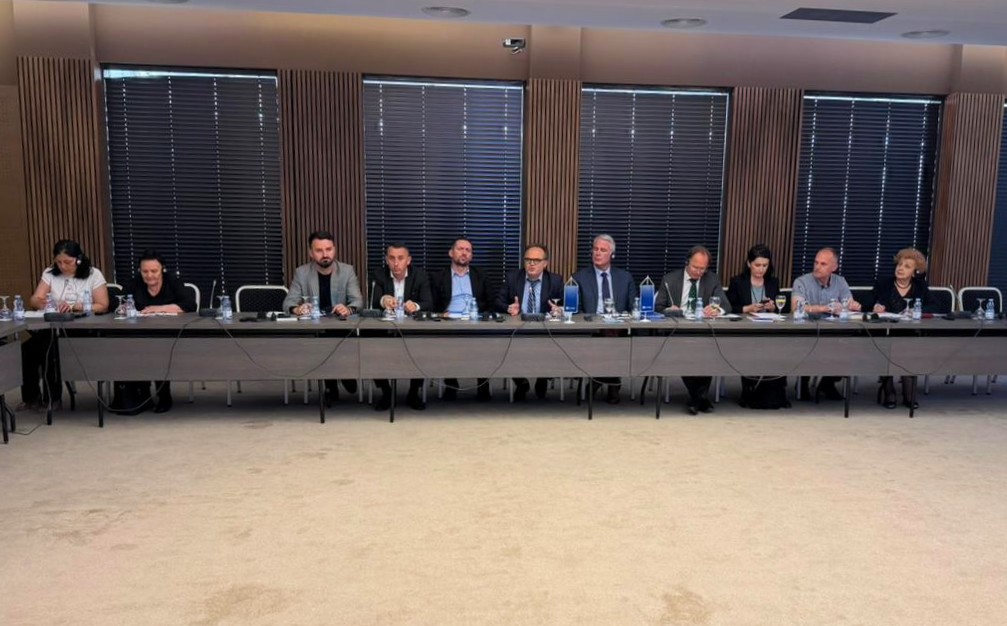
Pristina – The International Commission on Missing Persons (ICMP), with the support of the Government of the Kingdom of Sweden, convened a meeting on Thursday between associations representing families of missing persons from the Kosovo conflict—including Kosovo Albanian and Kosovo Serb families—and representatives of Kosovo institutions responsible for locating and identifying missing persons. The meeting underscored the importance of transparent communication, cooperation, and sustained engagement with families.
The meeting brought together representatives of the Kosovo Government Commission on Missing Persons (GCMP), the Institute of Forensic Medicine (IFM), associations of families of the missing, and representatives of the Embassy of Sweden in Kosovo.
Matthew Holliday, ICMP’s Program Director for Europe, emphasized the importance of ensuring that families remain informed and engaged throughout efforts to account for missing persons.
“Families of the missing have the right to accurate information regarding the fate and whereabouts of their loved ones,” Holliday said. “Sustained dialogue between institutions and families is essential to maintaining confidence in the process and advancing efforts to identify those who are still missing.”
During the meeting, representatives of the GCMP and IFM provided updates on ongoing efforts to review unidentified human remains and advance identifications. Representatives of family associations were able to engage directly with institutional representatives, ask questions, and discuss challenges related to the process.
Family representatives stressed that time is becoming an increasingly critical factor in their search for answers, noting that many relatives of the missing have passed away without learning the fate of their loved ones. They also called for regular meetings with the responsible institutions and for intensified efforts to resolve the remaining cases.
The Ambassador of Sweden to Kosovo, Jonas Westerlund, reaffirmed Sweden’s commitment to supporting efforts to account for the missing.
“Sweden will continue to support ICMP, work closely with family associations of missing persons, and encourage continued efforts to resolve all 1,568 active missing persons cases,” Ambassador Westerlund said.
As part of the program, participants visited the facilities of the Institute for Forensic Medicine, where they were introduced to the forensic procedures and technical capabilities used in the identification process.
More than 75 percent of the approximately 40,000 persons reported missing following the conflicts in the former Yugoslavia have been accounted for—a rate unmatched in post-conflict contexts elsewhere in the world. ICMP continues to work with governments, institutions, and families across the region to support a sustainable, rule-of-law-based process to account for those who remain missing.
About ICMP
ICMP is a treaty-based intergovernmental organization headquartered in The Hague, the Netherlands. Its mandate is to secure the cooperation of governments and others in locating missing persons resulting from conflict, human rights abuses, disasters, organized crime, migration, and other causes, and to assist them in doing so.