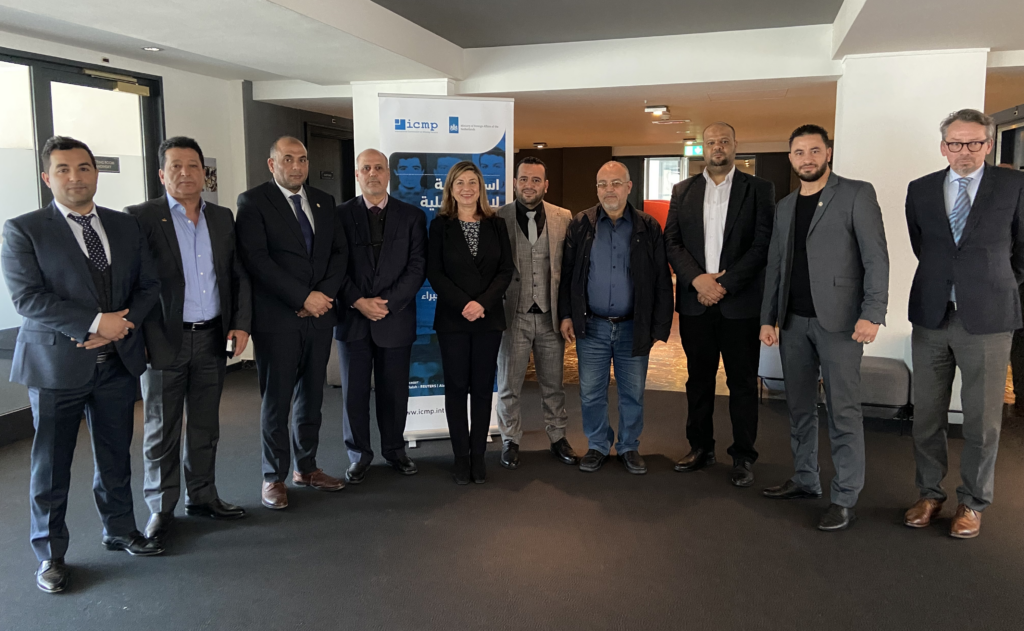
The Hague, 20 March: — The newly-formed Libyan Expert Group on Missing and Disappeared Persons held its first meeting in The Hague this week. The work of the Expert Group, is supported by the International Commission on Missing Persons (ICMP) and includes representatives from the Ministry of Justice, the Ministry of Interior, the General Authority for the Search and Identification of Missing Persons (GASIMP), and other Libyan forensic, judicial and law enforcement experts.
This week’s meeting focused on steps that will strengthen the legal and institutional framework in Libya, enhance standards and procedures applied in investigations, strengthen forensic capacities, and enhance data privacy measures and work with families of the missing. Participants also discussed measures that are urgently needed to protect and investigate mass graves in and around Tarhuna.
Speaking on Saturday at the close of the two-day meeting, ICMP Director-General Kathryne Bomberger said an effective missing persons process in Libya will benefit from the creation of a central record, enhanced cooperation between the relevant institutions, a program of capacity building, and a dedicated DNA workflow to deal with all missing persons, whether they are Libyan or non-Libyan.
“Libya has made a lot of progress since 2013 in laying the groundwork for a sustainable missing persons process that is based on the rule of law,” said Ms. Bomberger. “The challenge for Libya is to deal with a large number of persons, including Libyans and non-Libyans. The Expert Group members expressed a strong willingness to enhance coordination, including the creation of a Central Record.”
GASIMP President Kamal Abubakar said the Libyan authorities fully understand the need to address the issue of missing persons in a coordinated way. He said many of the responsible agencies already cooperate effectively and that this can be enhanced.
Dr. Anwar Elarbi, Head of the Forensic Medicine Department and Director of Administration of Forensics and Analysis at the Center of Judicial Expertise and Research of the Ministry of Justice, noted that domestic coordination is essential to ensure that the missing persons process is conducted without duplicating efforts.
Professor Othman Elzentani, Senior Consultant of Forensic Medicine for the Center of Judicial Expertise and Research at the Ministry of Justice stressed the efforts that all the institutions are making to address the issue of missing persons, including in the Tarhu)*9na context.
Mahmoud Ashour Al-Ajili Head of the Criminal Investigations Department at the Ministry of interior said that investigation procedures are following strict standards and institutions are all cooperating with the Prosecutor General’s Office.
Between 2012 and 2014, with support from the United States State Department Bureau of Democracy, Human Rights and Labor (DRL), the United Kingdom and Denmark, ICMP helped the Libyan Authorities to lay the foundations for a sustainable and impartial missing persons process. ICMP worked with Libyan stakeholders to create data systems capability, including online missing persons tools; it supported the development of the Libyan Identification Center, and provided dedicated training to Libyan experts. During the two-year ICMP program, more than 11,000 genetic reference samples were collected from families of the missing, representing more than 2,500 persons who went missing in Tripoli, Sabha, Ben Walid, Sirte and other places. ICMP helped to identify the remains of 150 people through a DNA-led process, including Dr Mansour Rashid Kikhia, a well-known dissident under the Gaddafi regime; work also began on improving technical forensic capacity and the institutional and legal framework, as well as facilitating cooperation between the authorities and families of the missing and enabling families to play a meaningful role in the overall process.
In January 2021, ICMP issued an Assessment Report on current efforts to account for missing persons in Libya. The Report identified key legislative, institutional and technical steps to maintain a sustainable and effective process. These include possible amendments to current Libyan legislation; ratification of the International Convention on the Protection of All Persons from Enforced Disappearance; the development of data-protection legislation; and measures to enhance legal certainty for families, for example by creating a Declaration of Absence that can enable families to access pensions and other benefits after a relative has gone missing.
At the conclusion of this week’s meeting, members of the Expert Group agreed on the following steps towards a sustainable process to account for missing persons:
- Strengthen the legal and institutional framework;
- Enhance standards and procedures applied in investigations and strengthen forensic capacity, including in mass and clandestine graves scenarios; and
- Guarantee the rights of families of the missing.
Prior to 2011, forced disappearances in Libya were linked to violations of human rights perpetrated under the Gaddafi regime, or were a consequence of conflict. Since 2011, widespread violations of human rights law and international humanitarian law have been recorded, including forced disappearances. Additionally, an unknown number of persons have gone missing while crossing or departing Libya as part of migratory journeys.
This week’s meeting will be followed by an online roundtable and a series of Dialogues bringing together Libyan and international experts.
The launch of the Libyan Expert Group is supported by the Government of the Netherlands.
About ICMP
ICMP is a treaty-based intergovernmental organization that seeks to ensure the cooperation of governments and others in locating missing persons from conflict, human rights abuses, disasters, organized crime, migration, and other causes, and to assist them in doing so. ICMP also supports the work of other organizations in their efforts, encourages public involvement in its activities and contributes to the development of appropriate expressions of commemoration and tribute to the missing.