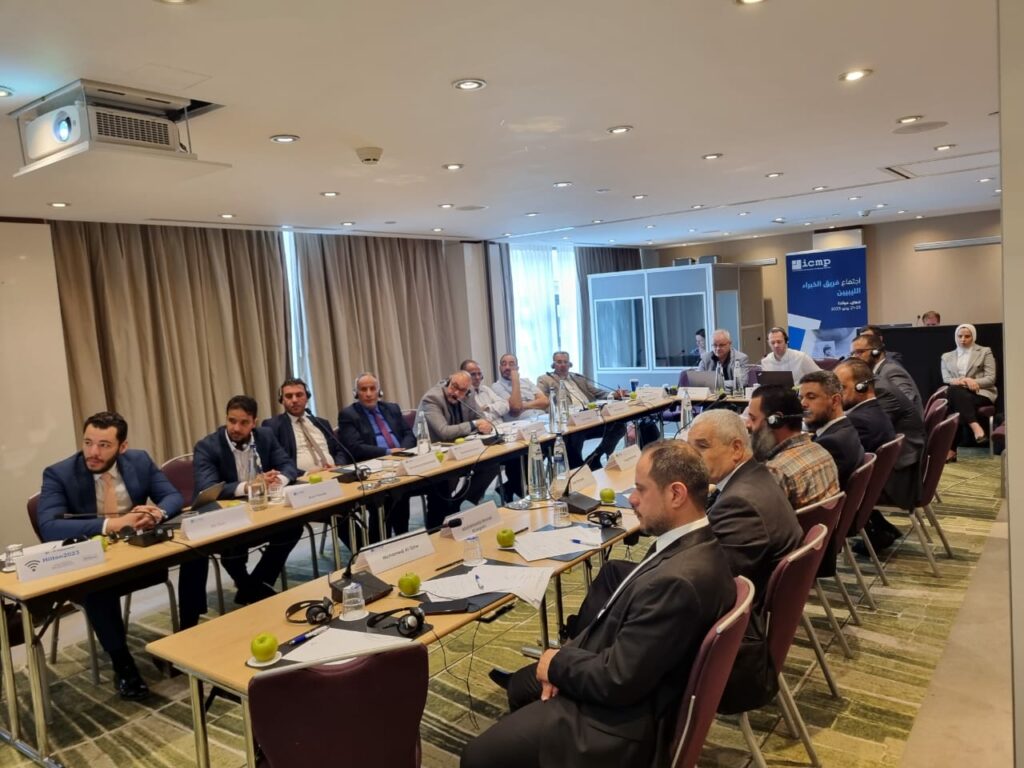
The Hague, 28 June 2023: Experts from Libyan institutions have completed a two-day visit to the Headquarters of the International Commission on Missing Persons (ICMP) in The Hague. Representatives included experts from the Ministry of Interior, the Ministry of Health, the Ministry of Foreign Affairs, and the Ministry of Justice (Technical Permanent Committee on Mass Graves and Missing Migrants). During the study visit, the experts were briefed on measures to enhance their work in locating missing migrants and other missing persons and investigating disappearances in line with the rule of law.
Participants were able to see at first hand ICMP’s Integrated Data Management System (iDMS), which has helped to account for tens of thousands of people globally. They also attended presentations on methodologies for collecting and analyzing missing persons data, and during a tour of ICMP’s Human Identification laboratory they were briefed on the latest DNA identification techniques.
“This visit enhanced the partnership between ICMP and the Libyan authorities,” ICMP Libya Program Manager Mohamed Laswed said. He added that “it builds on the needs of Libyan partners, who have shown their determination to tackle the issue of missing migrants effectively.” Mr Laswed said this includes deploying impartial and efficient tools such as the iDMS and “extends to comprehensive strategies to search for, locate and identify missing migrants.” He said the Libyan authorities were focused on “the full spectrum of the process.”
More than 20,000 people are believed to have gone missing in Libya as a result of conflict, instability and human rights violations in recent decades. An unknown number of migrants have gone missing while crossing or leaving Libya.
Dr. Elias Elhammruni, who leads the Permanent Technical Committee, explained Libya’s focus: “Our central objective is to refine our systems to account in an effective manner for missing migrants in Libya. To reach this goal, we are keen to enhance our capacities and upgrade our training programs to reflect international standards. ICMP has pledged to assist us in these endeavors. This collaborative effort aligns seamlessly with the Ministry of Justice’s strategic vision, underlining our commitment to addressing this significant human rights issue through systematic improvements.”
ICMP is working with stakeholders in Libya to enhance standards and procedures in investigations at mass grave sites, to establish a centralized data system and enhance data privacy, to strengthen forensic capacities, and to increase the engagement of families in the missing persons process.
“Future cooperation with ICMP will focus on increasing the efficiency of personnel in performing technical tasks, and preparing a central database of missing persons,” said Major Ali Al-Busifi, Head of the Investigation Unit of the Criminal Investigation Department.
During the two-day visit, a Technical Operational Agreement was signed between ICMP and the Libyan Ministry of Justice.
About ICMP
ICMP is a treaty-based intergovernmental organization that seeks to ensure the cooperation of governments and others in locating missing persons from conflict, human rights abuses, disasters, organized crime, migration, and other causes, and to assist them in doing so. ICMP also supports the work of other organizations in their efforts, encourages public involvement in its activities and contributes to the development of appropriate expressions of commemoration and tribute to the missing.