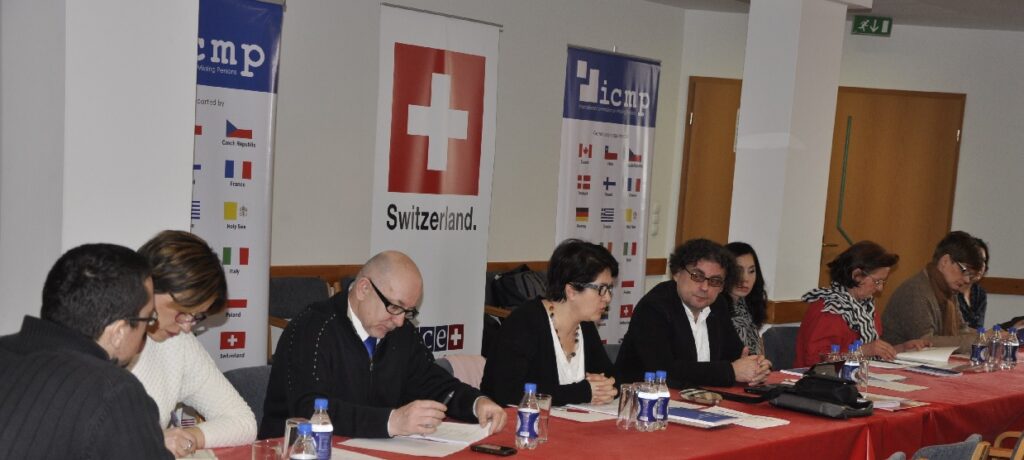
10 March 2015: Upholding the rule of law is key to sustaining the effort to account for the missing in Bosnia and Herzegovina as the country approaches the 20th anniversary of the end of the war, participants at a roundtable in Tuzla agreed today.
The roundtable, organized by the International Commission on Missing Persons (ICMP), brought together representatives of family associations and the authorities as well as academic and legal experts to discuss ways of increasing the effectiveness of efforts to account for the missing.
Participants noted that prosecuting war criminals and searching for their victims is not something that affects just families of the missing: it affects everyone, because if criminals walk free, citizens cannot rely on the protection of the law, and – in practical terms – if criminals walk free they will not be obliged to give up whatever information they may possess regarding the fate of those who are still missing.
Discussion at the roundtable revolved around the findings presented in the BiH Stocktaking Report published by ICMP in December, which describes two decades of efforts to account for the missing and examines specific issues in Lower Podrinje, Upper Podrinje, Herzegovina, Sarajevo, Posavina, Central Bosnia, Northeast Bosnia and Western Bosnia.
The Stocktaking Report includes the following recommendations:
– Bosnia and Herzegovina must sustain the effort to account for the remaining 8,000 persons missing from the conflict by ensuring that its institutions, including the Missing Persons Institute and the BIH Prosecutor’s Office remain strong and engaged;
– BIH must fully implement the Law on Missing Persons, which provides for the Central Records on Missing Persons (CEN), as well as for a Fund benefiting the families of the missing;
– BIH should explore new approaches to locating gravesites, including aerial and satellite imagery;
– The ongoing effort of systematically reassessing past processes in Bosnia and Herzegovina’s mortuaries should be continued as a priority;
– Associations of family members of missing persons should continue their lobbying efforts to claim their rights to truth and justice. In particular they should continue to convene annual Regional Conferences to advocate for their rights and to ensure that progress is sustained in the future;
– BIH must strengthen its domestic capacity in terms of forensic expertise; among other things, an Institute of Legal Medicine should be established in the FBIH, and the capacities of the RS Institute of Forensic Medicine should be strengthened; and
– Obstruction must end in regard to concluding bilateral agreements between Bosnia and Herzegovina and other countries in the region, and in regard to the establishment of a Regional List of Missing Persons that would eliminate duplicate records and jurisdictional impediments to progress on the issue.
Further roundtables will be organized in Mostar on 17 March, in Sarajevo on 19 March, and in Banja Luka on 26 March.