Srebrenica, 10 July 2025: – The work that continues today to locate and identify the victims of the 1995 Srebrenica Genocide is fundamental to securing truth and justice, the Director-General of the International Commission on Missing Persons (ICMP), Kathryne Bomberger, said this week.
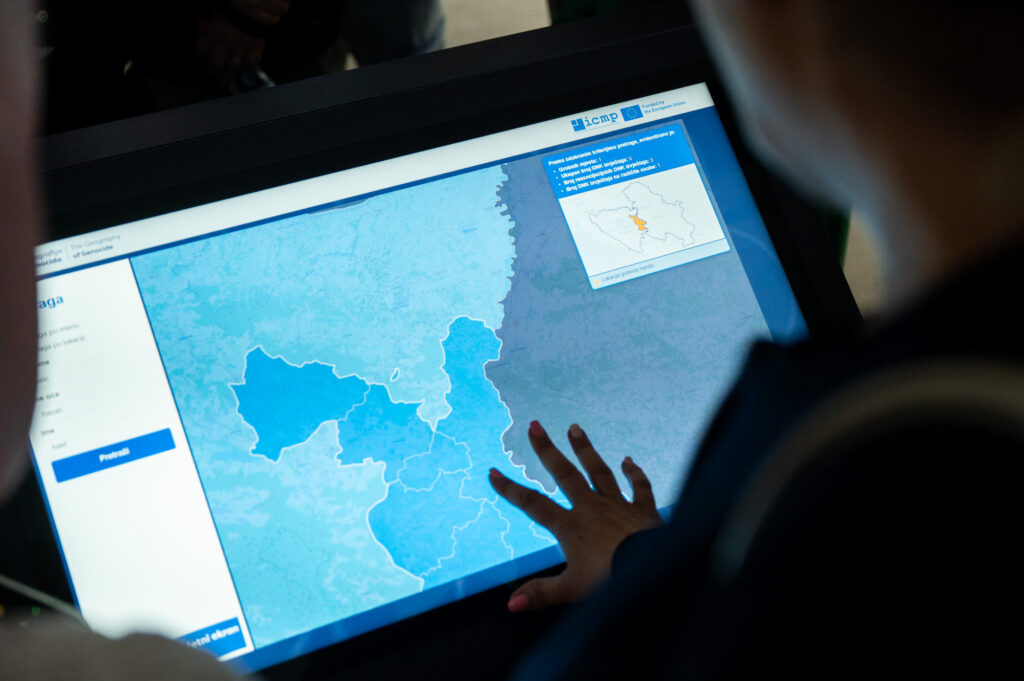
Speaking at a conference organized by the Srebrenica Memorial Center on Wednesday, Ms Bomberger previewed “The Geography of Genocide”, a permanent exhibition and interactive map that has been created by ICMP with the support of the European Union and which will be officially opened for the International Day of the Disappeared.
The Geography of Genocide, housed in the Srebrenica Memorial Center in Potocari, Bosnia and Herzegovina, explains the process that has made it possible to account for more than 90 percent of the Srebrenica victims.
Ambassador Luigi Soreca, Head of the EU Delegation and EU Special Representative in Bosnia and Herzegovina said, “30 years on from the genocide in Srebrenica, the grief of survivors and families of victims remains deep and profound. Valuable work being done by the ICMP is essential for truth and justice, remembrance, and the fight against genocide denial. The genocide in Srebrenica was the biggest atrocity in Europe since the Second World War. For the EU, truth, justice and accountability are a matter of principle and fundamental values. I am proud that the EU was able to support the outstanding ‘Geography of Genocide’ project”.
The interactive map that is part of the exhibition allows visitors to see the connections between primary and secondary mass graves and to pinpoint the exact place where human remains of identified victims were found. “Families can search by name,” Ms Bomberger said. “The map shows exactly where the remains of that person were found, when they were exhumed and when they were identified. It tells the story of what happened to the human remains of individual victims. There is a huge volume of documented information that can now be accessed by families of the missing.”
The Geography of Genocide also lays out the political and scientific evolution of the identification process, which, Ms Bomberger noted, “was very radical when it was first proposed – because the new technologies that were developed to support the process made it possible to link victims to the original crime scene. Every bone fragment that is recovered becomes part of a scientific mosaic that restores the identity of victims and uncovers a true account of what happened.”
In 2000, ICMP began gathering DNA profiles from families of the missing in the former Yugoslavia, including families from Srebrenica. Using customized database technology, the profiles were compared with DNA extracted from human remains found in mass and clandestine graves. ICMP made the first match – of a 15-year old boy from Srebrenica – in 2001. Following this, the number of persons identified, not only from Srebrenica but from the region as a whole, increased at a remarkable rate. More than 20,000 relatives of those who disappeared in Srebrenica in July 1995 have provided genetic samples and relevant information about their missing relatives, enabling the conclusive identification of more than 7,000 Genocide victims. Identifications are still being made.
The interactive map can be accessed at https://srebrenica.icmp.int/
About ICMP
ICMP is a treaty-based intergovernmental organization with Headquarters in The Hague, the Netherlands. Its mandate is to secure the cooperation of governments and others in locating missing persons from conflict, human rights abuses, disasters, organized crime, migration and other causes and to assist them in doing so. Created at the 1996 G-7 Summit to address the issue of persons missing as a consequence of the conflicts in the Western Balkans, ICMP has been working globally since 2004.