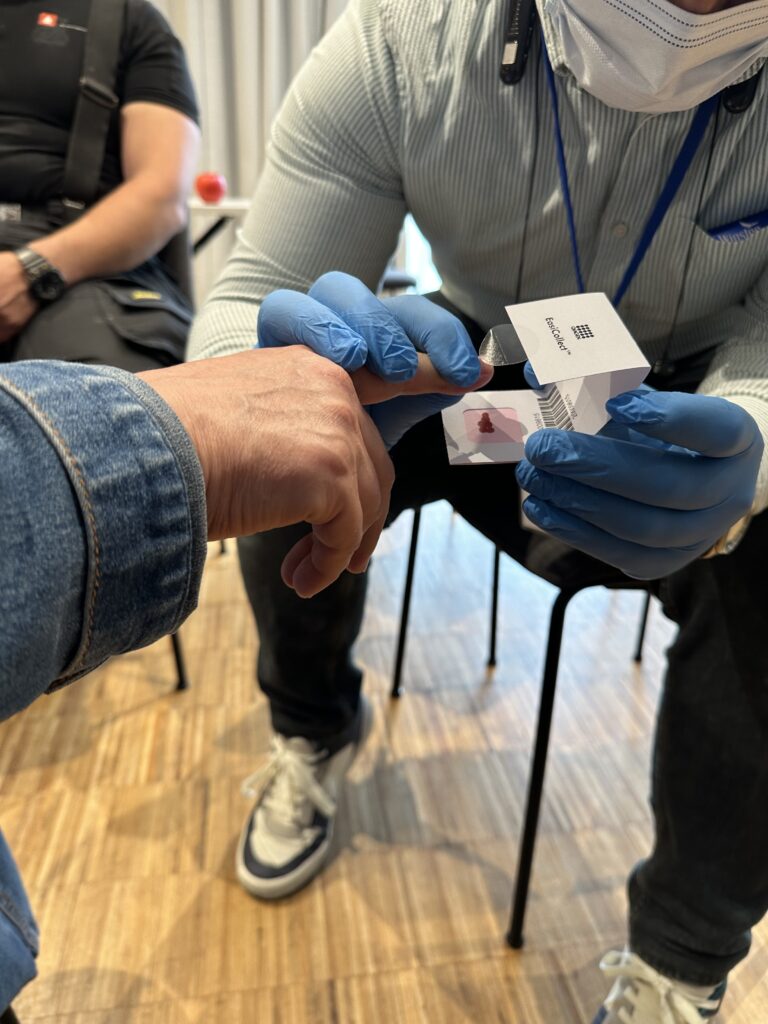
The Hague, 26 June 2025 – The International Commission on Missing Persons (ICMP) has completed its fourth genetic reference sample collection campaign from Syrian families living in Europe. Building on the momentum of the three previous campaigns, families of the missing in four European countries were invited to provide samples to help identify people who have gone missing either inside Syria or along migration routes.
Over a two-week period in May and June, ICMP teams collected reference samples from Syrian families in Stockholm and Malmö in Sweden; Copenhagen in Denmark; The Hague, Oldenzaal, Rotterdam, Simpelveld, and Nieuw-Vennep in the Netherlands; and Düsseldorf, Neuss, Dortmund, Bocholt, Bochum, Rheine, Recke, Osnabrück, Münster, Sendenhorst, Bielefeld, Enger and Hanover in Germany. In addition to collecting samples, the campaign encouraged Europe-based Syrian families to report missing relatives using ICMP’s Online Inquiry Center (OIC).
More than 120 sampleswere collected in the latest campaign, and more than 800 families have provided DNA reference samples over the course of the whole program. ICMP has also collected non-DNA data, inside and outside Syria, from 80,000 families of the missing who have reported more than 30,000 missing relatives.
“The participation of families of the missing contributes to establishing a reliable and accurate foundation for processes to locate the missing and supports the development of a Syrian-led process that upholds the right of families to the truth, justice and reparations,” Ms. Bomberger said. She added that this approach “ensures inclusive representation of all families irrespective of ethnicity, gender, religion, circumstances of disappearance or any other factor.”
National authorities are responsible for locating missing persons and investigating their disappearance. Now that Syria has created a National Commission for the Missing , which was established by Presidential Decree on 17 May 2025, ICMP recommends that the new National Commission, together with Syrian families of the missing, civil society organizations, and international organizations, including the UN Independent Institution on Missing Persons (IIMP), ICMP, ICRC and others, develop a strategy for the missing persons process in Syria that includes how data concerning missing persons will be collected and what a future central record or shared data system will look like.
“Families are rights-holders, and they have the right to be active participants throughout the process of locating their loved ones and investigating their disappearance, including how their data will be collected and how it will be used,” said ICMP Director-General Kathryne Bomberger. “Their engagement in providing data safeguards vital evidence and this will help in building the new Syrian Commission on Missing Persons. It will also enhance evidentiary documentation that supports a systematic verification of facts and establishes a clearer understanding of the truth regarding human rights violations and abuses committed in Syria,” she said.
Estimates of the number of people missing from Syria run as high as 200,000. This includes persons missing as a consequence of summary execution, arbitrary and incommunicado detention, kidnapping and abduction, enslavement, sarin gas attacks, forced displacement and migration, as well as other human rights abuses. The fighting and day-to-day ravages of war have also resulted in combatants and civilians of many nationalities going missing. Syrians have sought refuge in Jordan, Lebanon and Turkey, or have joined the dangerous migration across the Mediterranean.
In 2023, at the request of the Greek authorities, ICMP provided assistance to identify Syrian victims who were among more than 500 migrants drowned in the Pylos shipwreck. Samples collected by ICMP from relatives of the missing were profiled at ICMP’s laboratories and with the permission of the relevant families the profiles were shared with the Greek authorities, resulting in DNA-based identifications.
The DNA collection campaign was made possible through the generous support of the German Federal Foreign Office.
About ICMP
ICMP is a treaty-based intergovernmental organization with Headquarters in The Hague, the Netherlands. Its mandate is to secure the cooperation of governments and others in locating missing persons from conflict, human rights abuses, disasters, organized crime, irregular migration and other causes and to assist them in doing so. ICMP also supports the work of other organizations in their efforts, encourages public involvement in its activities, and contributes to the development of appropriate expressions of commemoration and tribute to the missing.