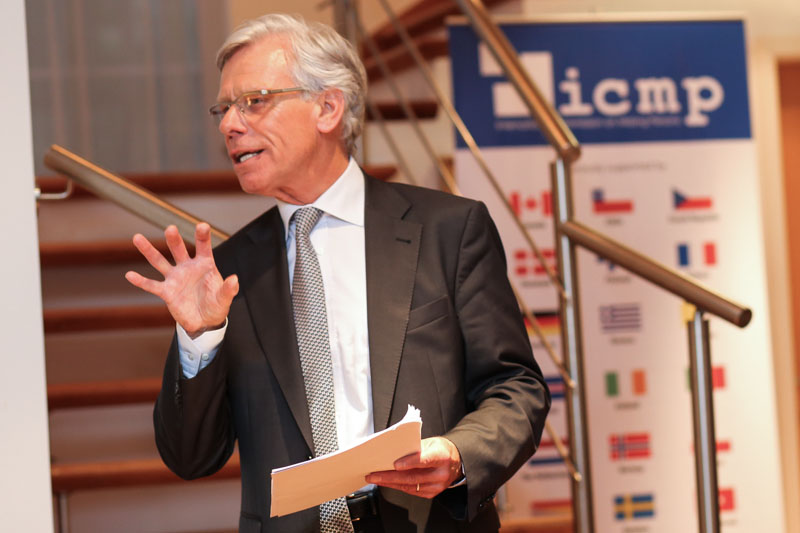
25 April 2014: ICMP’s Commissioner, the distinguished Norwegian diplomat, Ambassador Knut Vollebaek, visited Bosnia and Herzegovina from April 23rd to 25th to review progress made in accounting for persons missing from the conflicts of the 1990’s. During his first visit to BiH as an ICMP commissioner, Vollebaek visited ICMP’s facilities and met with the Chief Prosecutor, the Board of Directors of the Missing Persons Institute, members of the Regional Coordination of Missing Persons Family Associations as well as representatives of the International Community.
“Today, over 28,000 persons, or over 70 percent of the 40,000 persons who went missing have been accounted for. For anyone who is unfamiliar with the issue of missing persons globally, I would like to underscore that this achievement is unique. There are no parallels, or comparable efforts anywhere in the world to account for missing persons following conflict or systematic human rights abuses”, Vollebaek said. “The achievements in the Western Balkans and particularly in Bosnia and Herzegovina, in accounting for the missing genuinely serve as a model for the rest of the world. Key factors that contributed to this success are the engagement of the families of the missing, the huge scientific advancements in recent years, the continuous support of the International Community and the treatment of the issue of missing persons as a rule-of-law process, rather than as purely a humanitarian issue.”
During his meeting with Mr. Goran Salihović, the BIH Chief Prosecutor, Ambassador Vollebaek expressed ICMP’s full support for the ongoing excavations process. He also commended the Working Group on unidentified (NN) remains which seeks to review and resolve thousands of missing persons cases held in mortuaries throughout BIH.
While speaking to the members of the Board of Directors of the BiH Missing Persons Institute, Mr. Amor Mašović, Mr. Marko Jurišić and Mr. Milutin Mišić, Ambassador Vollebaek called for the governments of the region to stay committed to cooperation and to exchange data about the missing persons. The sustainability and non-discrimination in the process of searching and identification must not be brought in question, he added. Mr. Vollebaek also underscored ICMP’s intention to remove itself from the position of co-founder of the MPI this year, a role that ICMP has occupied since the creation of MPI in 2005.
In meetings with the Head of EU Delegation Ambassador Peter Sorensen and the Head of OSCE Mission Ambassador Fletcher Burton, Ambassador Vollebaek discussed the vital role of the political and financial support provided by the European Union and by many of their member states. He thanked the EU and the OSCE for their ongoing support to the process and to ICMP’s unprecedented results to account for missing persons from the conflicts of the 1990’s.
During his meetings with family members of missing persons Vollebaek praised their efforts to take an active role in the process, to speak with one voice and to hold authorities across the region accountable. Vollebaek highlighted the families’ success in having 2014 proclaimed as the Year of the Missing by the Parliaments of BiH, Croatia and Serbia and he called on them to remain strong, engaged and united in their common cause.
Ambassador Vollebaek also toured ICMP’s headquarters in Sarajevo, as well as ICMP’s identification facilities in Sarajevo and Tuzla, where he was introduced to ICMP’s current activities.
ICMP’s commissioners are a group of eminent individuals who represent ICMP at the highest diplomatic level. ICMP’s commissioners include Her Majesty Queen Noor; former Prime Minister of the Netherlands Mr. Wim Kok; former OSCE High Commissioner on National Minorities Ambassador Rolf Ekeus; former Minister of Foreign Affairs of Colombia Ambassador Carolina Barco; former Norwegian Minister of Foreign Affairs Ambassador Knut Vollebæk, former Foreign Office Minister Mr. Alistair Burt and ICMP’s Chairman Ambassador Thomas Miller.
The ICMP is the only specialized international organization that addresses the issue of missing persons in all of its facets. The ICMP was created at a G-7 Summit in 1996 in Lyon, France and is headquartered in Sarajevo.