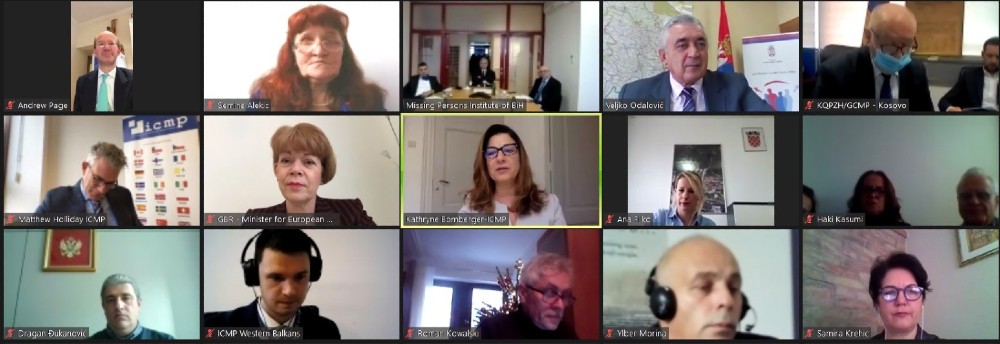
[:en]Sarajevo, 16 December 2020 – In an event today with representatives of the Berlin Process participants, members of the Western Balkan Missing Persons Group (MPG) said they plan to intensify their cooperation, information sharing and engagement with families to strengthen work to account for missing persons across the region.
The MPG comprises senior representatives of the institutions in the region that are responsible for addressing missing persons issues. It was created in 2018, in the context of the Western Balkans Berlin Process, to strengthen efforts to find those who remain missing following the 1990s conflicts on the territory of former Yugoslavia.
The group presented its second annual report during the event, which was co-organized by the United Kingdom Foreign, Commonwealth and Development Office and the International Commission on Missing Persons (ICMP). The report notes the MPG’s efforts to actively involve families of the missing in the regional cooperation process by sharing information with families and the Regional Coordination of Associations of Families of the Missing from the Former Yugoslavia (RC).
RC Chairperson Semina Alekic said: “The MPG has shown responsibility and dedication to implementation of the Framework Plan by making additional efforts to overcome obstacles caused by the Covid-19 pandemic; Its members have continued regional cooperation by exchanging information and making progress through joint activities.”
Wendy Morton, Minister for European Neighbourhood and the Americas in the UK Foreign Commonwealth and Development Office, said, “The Missing Person’s Group, working with the ICMP, has achieved a lot in a short space of time accounting for thousands of missing people, but we owe it to all the families of those still missing to continue the search.
“The regional cooperation process, with families of the missing at its heart, offers the region the best chance to heal, and move forward and prosper.”
ICMP Director-General Kathryne Bomberger said: “In the Western Balkans, over 70 percent of the around 40,000 persons reported missing after the conflicts in the 1990s have been accounted for – this is a success in comparison with other post-conflict regions. Regional cooperation has been crucial to this achievement, as has the continuous support of the UK Government and other donors. This form of regional, multilateral cooperation could be used as inspiration in other post-conflict areas facing complex missing persons situations.”
The annual report also notes that increased cooperation between MPG members made it possible to identify human remains that had been unidentified for almost two decades. It highlights MPG members’ use of the Regional Database, which is the only database of its kind in the world, to exchange information about active missing persons cases in a transparent manner and in real time.
Looking ahead, the MPG plans to strengthen its impact through enhanced multilateral cooperation that supports existing bilateral cooperation.
The MPG supervises operations under a Framework Plan signed in November 2018 at ICMP’s Headquarters in The Hague.
The Framework Plan stems from a Joint Declaration on Missing signed in London in July 2018 in which the Prime Ministers of Bosnia and Herzegovina, Kosovo, Montenegro, Serbia, Albania, Croatia, Germany, the United Kingdom, Austria, Bulgaria, France, Italy, Slovenia and Poland reiterated their commitment to support efforts to account for 12,000 people who are still missing as a result of the conflicts in the former Yugoslavia.
The MPG’s first annual report was presented at the Berlin Process Summit in Poznan, in July 2019.
About ICMP
ICMP is a treaty-based intergovernmental organization with Headquarters in The Hague, the Netherlands. Its mandate is to secure the cooperation of governments and others in locating missing persons from conflict, human rights abuses, disasters, organized crime, irregular migration and other causes and to assist them in doing so. It is tasked exclusively to work on the issue of missing persons.
[:bs]Sarajevo, 16. decembar 2020. godine – Na današnjem skupu, kojem su prisustvovali učesnici Berlinskog procesa, članovi Grupe za nestale osobe za područje zapadnog Balkana (GNO) kazali su kako planiraju intenzivirati međusobnu saradnju, razmjenu informacija i rad s porodicama u cilju daljnjeg intenziviranja rada na rješavanju pitanja nestalih širom regije.
Članovi GNO-a su viši predstavnici institucija iz regije koje su nadležne za rješavanje pitanja nestalih. Fomiran je 2018. godine, u kontekstu Berlinskog procesa za zapadni Balkan, kako bi ojačao napore na pronalaženju osoba nestalih usljed sukoba 1990-ih godina na području bivše Jugoslavije.
Grupa je predstavila svoj drugi godišnji izvještaj tokom ovog skupa, koji su zajedno organizovali Ministarstvo vanjskih poslova Ujedinjenog Kraljevstva (UK) i Međunarodna komisija za nestale osobe (ICMP). Izvještaj govori o nastojanjima GNO-a da aktivno uključi porodice nestalih u procese regionalne saradnje putem razmjene informacija s porodicama i kroz Regionalnu koordinaciju udruženja porodica nestalih s područja bivše Jugoslavije (RK).
Semina Alekić, predsjedavajuća RK-a kazala je: „GNO je pokazao odgovornost i posvećenost provedbi Okvirnog plana uloživši dodatni napor kako bi savladali prepreke koje je sa sobom donijela pandemija bolesti Covid-19. Njegovi članovi su nastavili saradnju na regionalnom nivou, razmjenjujući informacije i ostvarujući napredak kroz zajedničke aktivnosti.“
Wendy Morton, ministrica za Evropu i Ameriku u Ministarstvu vanjskih poslova UK, izjavila je:
„Grupa za nestale osobe, radeći s ICMP-om, postigla je puno u kratkom vremenskom periodu pronalaskom i identifikacijom hiljada nestalih, ali svim porodicama koje još uvijek traže svoje nestale dugujemo nastavak potragu. Proces regionalne saradnje, u čijem su srcu porodice nestalih, pruža regiji najbolju šansu za oporavak i da krene naprijed.“
Kathryne Bomberger, generalna direktorica ICMP-a, rekle je: „na zapadnom je Balkanu pronađeno i identifikovano više od 70 procenata od oko 40.000 osoba čiji je nestanak prijavljen nakon sukoba 1990-ih – što predstavlja uspjeh u poređenju s drugim poratnim područjima. Regionalna saradnja je ključna za ovo postignuće i odvija se uz stalnu podršku Vlade UK i drugih donatora. Ovaj vid regionalne, multilateralne saradnje može poslužiti kao inspiracija drugim poratnim područjima koja se suočavaju sa složenim pitanjem nestalih osoba.“
U godišnjem izvještaju je istaknuto kako je poboljšanje saradnje između članova GNO-a omogućilo identifikaciju posmrtnih ostataka koji su ležali neidentifikovani gotovo dvije decenije. Naglašeno je kako članovi GNO-a primjenjuju Regionalnu bazu podataka – jedinu svoje vrste u svijetu – u procesu razmjene informacija o aktivnim slučajevima nestalih osoba na transparentan način i u stvarnom vremenu.
U narednom periodu GNO planira jačati svoj utjecaj kroz još bolju multilateralnu saradnju na temelju postojeće bilateralne saradnje.
GNO nadgleda aktivnosti unutar Okvirnog plana koji je u novembru 2018. godine potpisan u ICMP-ovom sjedištu u Hagu.
Okvirni pan proističe iz Zajedničke deklaracije o nestalim osobama, potpisane u julu 2018. godine u Londonu, kada su predsjedavajući Vijeća ministara i premijeri Kosova, Crne Gore, Srbije, Albanije, Hrvatske, Njemačke, Ujedinjenog Kraljevstva, Austrije, Bugarske, Francuske, Italije, Slovenije i Poljske ponovili svoju posvećenost nastojanjima da se pronađe i identifikuje 12.000 osoba nestalih usljed sukoba na prostoru bivše Jugoslavije za kojima se još uvijek traga.
Prvi godišnji izvještaj GNO-a predstavljen je na samitu Berlinskog procesa u julu 2019. godine u Poznanju.
O ICMP-u
ICMP je sporazumom utemeljena međuvladina organizacija sa sjedištem u Hagu u Nizozemskoj. Njegov mandat je osigurati saradnju vlada i drugih organa vlasti u pronalaženju osoba nestalih usljed sukoba, kršenja ljudskih prava, nesreća, organiziranog kriminala, ilegalnih migracija i drugih razloga te pružiti im pomoć u tim procesima. ICMP radi isključivo na rješavanju pitanja nestalih osoba.
[:]