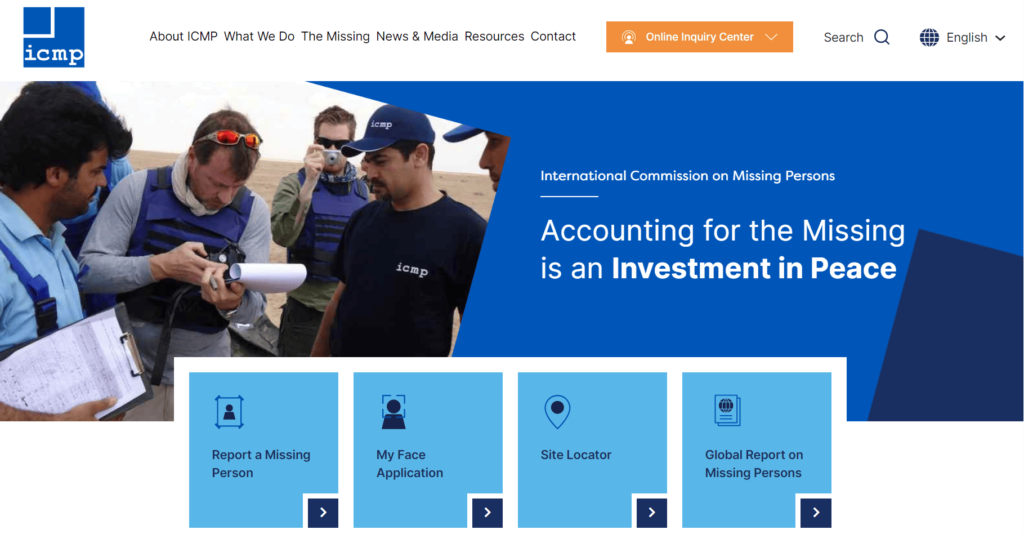
The Hague, 6 June 2024 – The International Commission on Missing Persons (ICMP) has launched a new multilingual website, www.icmp.int that provides information on the global challenge of missing persons, and access to tools through which families of the missing, governments, prosecutors, forensic experts and others can gather and share information about individual missing persons cases.
The website, which went online today, provides:
- In-depth coverage of the global missing persons issue, emphasizing state responsibility and the rights of families of the missing;
- A comprehensive overview of ICMP’s geographic, horizontal, and thematic programs;
- Interactive content, including videos, and graphics;
- Strategic filter options that allow users to access relevant resources and documents;
- Access to ICMP’s Online Inquiry Center; and
- Accessibility in English, Arabic, Bosnian/Croatian/Serbian, Spanish, and Ukrainian.
“The ICMP website is a resource that can be used by governments, organizations and individuals working on the issue of missing persons,” ICMP Director-General Kathryne Bomberger said today. “It is designed not only to provide commentary and context on the issue of missing persons, but to serve as a gateway to practical solutions.”
Ms Bomberger expressed appreciation for the long-term support provided to ICMP programs around the world by the German Federal Foreign Office. The new website was made possible through funding from the FFO. “We are grateful for Germany’s support, which is concrete, targeted and effective,” she said. “The website is a window on ICMP’s work and on the issue of missing persons from conflict, disasters, crime and other causes. It plays an important role in implementing ICMP’s global mandate.”
In addition to the website, information about ICMP activities and events can be accessed by following ICMP on X, LinkedIn, Facebook, and YouTube.
About ICMP
ICMP is a treaty-based intergovernmental organization with Headquarters in The Hague, the Netherlands. Its mandate is to secure the cooperation of governments and others in locating missing persons from conflict, human rights abuses, disasters, organized crime, migration and other causes and to assist them in doing so.