Kyiv, 10 February 2026: The International Commission on Missing Persons (ICMP) aims to intensify its efforts to help Ukraine advance a comprehensive system for locating more than 80,000 people who are missing as a result of Russia’s full scale invasion, ICMP Commissioner Bert Koenders said this week at the conclusion of a visit by an ICMP delegation to Kyiv.
“ICMP is providing extensive support to Ukraine in locating the increasingly large numbers of missing persons in a manner that adheres to the rule of law,” Mr Koenders said. “The Ukrainian government and others have created an effective system, and our objective on this visit has been to identify the specific areas where we can provide the most needed and the most effective assistance.”
ICMP Director-General Kathryne Bomberger stressed that Ukraine has already made substantial progress in establishing a comprehensive and effective system that utilizes modern forensic science and database technology – which is especially impressive since this rule-of-law-based framework is being developed while the country is at war. She emphasized that cost-effective, scalable solutions are what Ukraine needs right now to address the challenge. “Together, ICMP and Ukraine, are working closely to develop and implement such solutions, which will not only fulfil the rights of families, but will strengthen investigations and case files for prosecution,” Ms Bomberger said.
Matthew Holliday, ICMP Program Director for Europe, noted that “With the cooperation of the relevant ministries and Ukrainian technical experts, ICMP is drawing on its experience elsewhere in the world to help the authorities ensure proper documentation and preservation of evidence from cases so that this can be used in future war crimes trials.” He added that ICMP is also working “to help Ukrainian civil society and associations of families of the missing increase the impact of their advocacy and take an active part in every stage of the missing persons process, from gathering data, including genetic data, to ensuring that the scale of the missing persons challenge is well understood.”
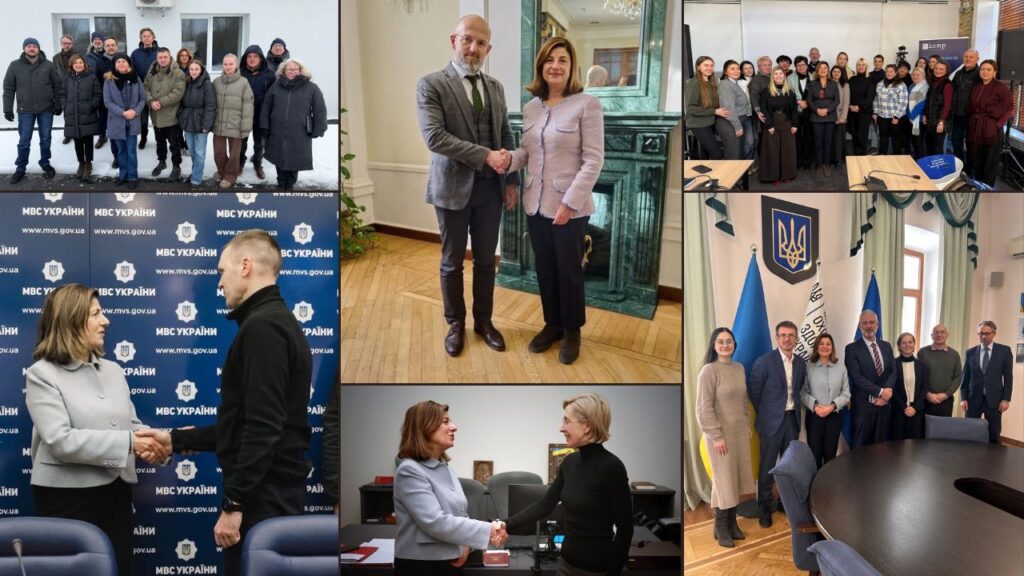
On 4 February, the delegation visited the Tsybli Human Identification Center in Kyiv Oblast. The Center was equipped with ICMP support and ICMP experts are providing training and technical assistance at the Center enabling the examination of complex cases of human remains repatriated from Russia.
As well as meeting representatives of family associations to explain ICMP’s work and learn more about the needs of families, ICMP met with Oleksandra Matviichuk, Head of the Center for Civil Liberties, to discuss the role of civil society in sustaining support for a rule-of-law-based missing persons process.
The delegation also met senior officials, including Irena Vereshchuk, Deputy Head of the Office of the President of Ukraine, Leonid Tymchenko, Deputy Minister of Internal Affairs, Oleksandr Karasyevich, State Secretary at the Ministry of Foreign Affairs, Ihor Kuzin, Deputy Minister of Health, the leadership of the Main Investigative Department of the National Police of Ukraine, and Olha Reshetilova, the Military Ombudsperson.
In addition, there were meetings with diplomatic representatives from Germany, the Netherlands, Canada, Sweden, and Australia, and senior officials from the EU Advisory Mission and the EU Service for Foreign Policy Initiatives, the UN Human Rights Monitoring Mission, the International Committee of the Red Cross, and the Geneva International Centre for Humanitarian Demining.
ICMP’s Ukraine Program is made possible through the generous support of Norway, Germany, the Netherlands, the United States, and Canada.
About ICMP
ICMP is a treaty-based intergovernmental organization with Headquarters in The Hague, the Netherlands. Its mandate is to secure the cooperation of governments and others in locating missing persons from conflict, human rights abuses, disasters, organized crime, migration and other causes and to assist them in doing so. ICMP also supports the work of other organizations in their efforts, encourages public involvement in its activities, and contributes to the development of appropriate expressions of commemoration and tribute to the missing.