The Hague, 11 November 2021 – The Policy Coordination Group (PCG), a Syrian-led initiative on the missing and disappeared facilitated by the International Commission on Missing Persons (ICMP), today finalized a draft paper on proposed constitutional principles related to Syria’s missing.
The constitutional principles not only address the legacy of systematic human rights violations in Syria, including the widespread practice of enforced disappearance, but also the need to establish rights-based guarantees to protect all persons from going missing or from being disappeared. The paper is divided into provisions directly related to the issue of missing persons, such as rights related to the dignity of life, safeguards against the deprivation of liberty, and transitional justice measures, and provisions indirectly linked to the issue that support a political transition based on the rule of law and the separation of powers.
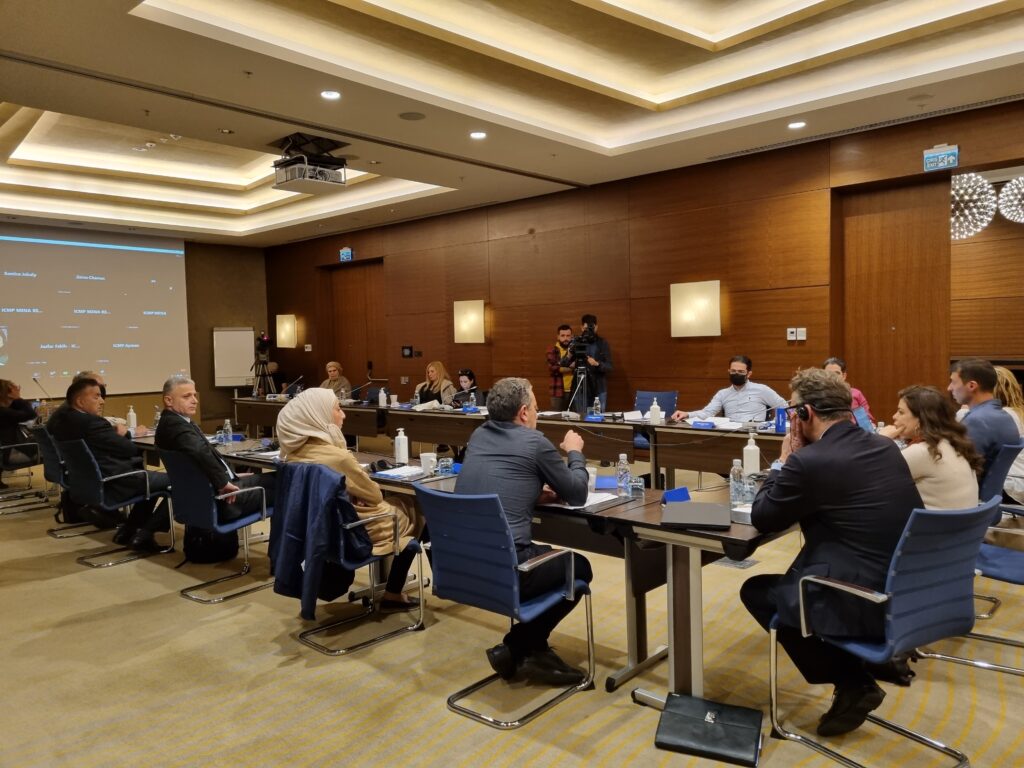
Today’s virtual meeting was the fifth session of the PCG since it was established following a conference organized by ICMP in The Hague in February 2020, which gathered a broad cross-section of stakeholders working on the issue of missing persons from Syria. The constitutional principles are based on recommendations discussed at the fourth session of the PCG, held in Istanbul, Turkey in October 2021.
“The work of the Syrian Policy Coordination Group shows that steps can be taken now to ensure that an effective missing persons process is established for Syria,” ICMP Director-General Kathryne Bomberger said. “These are concrete recommendations made by stakeholders who must be fully involved in peace-making and peacebuilding.”
“A future Syrian constitution must address the issue of Syria’s missing, principally by putting an end to the practice of enforced disappearances, as well as implementing mechanism to find the missing and to secure their rights and the rights of their families. Syrians have been subjected to this inhuman practice for decades”, said Nael Georges, ICMP’s PCG facilitator and researcher.
The PCG comprises 27 Syrian family associations, civil society organizations, and legal and human rights defenders as well as international advisors. It aims to develop broad recommendations and a policy framework for a future Syrian missing persons process, including the development of purpose-specific legislation and institutions and measures to provide reparations for families of the missing. It has discussed issues such as detention, mass graves and effective and secure ways of processing data related to missing persons.
More than 100,000 people are believed to be missing as a result of the conflict in Syria. In addition, the country has a legacy of missing and disappeared persons cases linked to human rights abuses and other causes prior to the conflict, and thousands of Syrians who have fled the fighting have gone missing along migratory routes.
ICMP’s assistance to the PCG is funded by the European Union (EU) through the support it provides to ICMP’s Syria program. The PCG is part of ICMP’s strategy to help lay the foundations for a sustainable missing persons process for Syria. ICMP is also actively engaged in creating a central data repository of missing persons from Syria. To date, ICMP has collected data from more than 60,000 Syrian families of the missing, including genetic reference samples for DNA testing and matching.
About ICMP
ICMP is a treaty-based intergovernmental organization with Headquarters in The Hague, the Netherlands. Its mandate is to secure the cooperation of governments and others in locating missing persons from conflict, human rights abuses, disasters, organized crime, irregular migration and other causes and to assist them in doing so. It is the only international organization tasked exclusively to work on the issue of missing persons.
ICMP’s assistance to the Syria Policy Coordination Group is funded by the European Union.