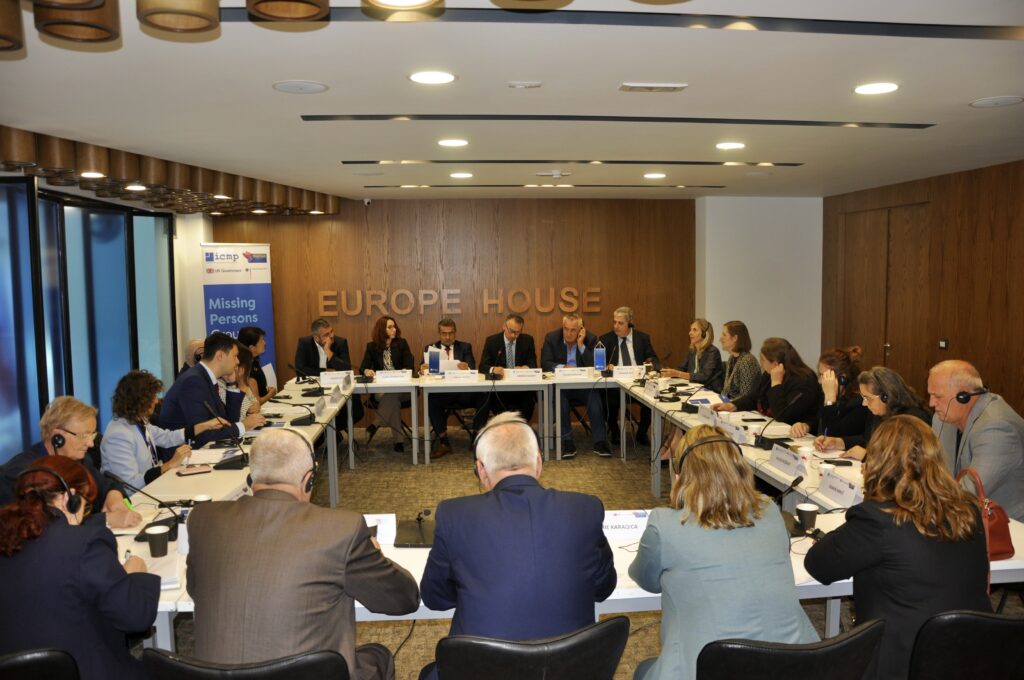
Tirana, 16 October 2023: Despite political tensions in the Western Balkans, significant progress has been made in accounting for those who are still missing from the conflicts of the 1990s. In a report presented today at the Berlin Process Summit in Tirana, the Western Balkans Missing Persons Group (MPG) highlighted practical results that have been achieved through focused multilateral cooperation among responsible government agencies.
The fourth MPG Performance Report, covering bilateral activities of domestic missing persons institutions between 1 July 2022 and 1 July 2023, focuses on the implementation of the multilateral Framework Plan that was signed in November 2018 at the Headquarters of the International Commission on Missing Persons (ICMP) in The Hague by domestic institutions from the region that are responsible for accounting for missing persons.
The MPG comprises Heads and other senior representatives of these institutions. The MPG is engaged in resolving the issues defined under the Framework Plan. The Framework Plan itself stems from a Declaration signed in London in July 2018, in which the Prime Ministers of Bosnia and Herzegovina, Kosovo, Montenegro, Serbia, Albania, Croatia, Germany, the United Kingdom, Austria, Bulgaria, France, Italy, Slovenia and Poland reiterated their commitment to support efforts to account for those who are still missing as a result of the conflicts in the former Yugoslavia. Activities under the Framework Plan are funded by the United Kingdom and Germany.
“The MPG is striving to ensure that the remaining 11,000 missing persons from the conflicts in the former Yugoslavia are accounted for, and that reliable and accurate information is provided to families of the missing through the MPG mechanism, the ‘Forum for Families’,” said Andreas Kleiser, ICMP Director for Policy and Cooperation. “The report presented today manifests the MPG commitment to fostering cooperation, transparency, and upholding the rights of families.”
Nikola Perisic, Chairman of the Board of Directors of the Missing Persons Institute of Bosnia and Herzegovina, said: “This form of multilateral cooperation, represents an irreplaceable mechanism when it comes to collaboration in the process of accounting for missing persons in the region. Among other results, I would like to emphasize the importance of establishing a unified Regional Database of active missing persons cases from conflicts on the territory of the former Yugoslavia.”
Andin Hoti, Chairman of the Kosovo Government Commission on Missing Persons, said: “Within the framework of the Berlin Process we have found a consensus on the annual report which was presented today. The Republic of Kosovo remains committed to the further intensification of regional cooperation in addressing the challenges that lie beyond our borders.”
Dragan Djukanovic, President of the Commission on Missing Persons of Montenegro, said: «The Government Commission on Missing Persons of Montenegro supports all activities of the Missing Persons Group, and we are pleased that the annual report presented today within the Berlin Process has been adopted. We are also glad that families are participating in the overall process. Every day, this group is strengthening more and more, and it will have the support of the Government of Montenegro for all future activities.»
Veljko Odalovic, President of the Commission on Missing Persons of the Government of the Republic of Serbia, said: “It’s good that this mechanism exists, and we should all do everything to keep it functioning. It’s a mechanism through which we can overcome some of our internal problems, and this report has shown that in this way we can reach agreements much easier than among ourselves. There is a need to exert more pressure on other domestic institutions participating in the process to collaborate more intensively with ICMP, as well as with each other, to address the issue of unidentified human remains in mortuaries in the region. It’s also crucial to insist on information about new locations since this is an area where there is the most room for improvement in our cooperation.”
Following the presentation of the MPG Report and a statement by the Head of the Regional Coordination Network of families of the missing (RCN), discussion on the report continued in the context of the Forum for Families. Representatives from domestic institutions engaged with members of the RCN Board to explore ways of enhancing cooperation on the issue of missing persons. The RCN, which brings together family associations of missing persons from Bosnia and Herzegovina, Croatia, Kosovo, Montenegro and Serbia, was formally established with the signing of a Memorandum of Understanding under ICMP auspices on 17 March 2022 in Sarajevo. Today’s Forum for Families was the second such event, following the inaugural Forum held in Podgorica in September 2022.
Haki Kasumi, Chair of the Committee of the Regional Network of Associations of Missing Persons Families from the territory of the former Yugoslavia, said: “Today we have participated in the most important meeting of this year. We, as families of the missing did our best and we have received promises from the institutions. Therefore, we hope that institutions will keep the promises and we we’ll have new results including efforts to locate potential graves as well as the resolution of unidentified cases in mortuaries in the region.”
ICMP, with the support of the governments of the United Kingdom and Germany, facilitates regional cooperation by fostering multilateral exchange including the use of modern technology such as a single, shared data repository that is available to the families of the missing. ICMP also works with family associations of the missing across the region to help them strengthen their advocacy capacity at a regional level.
The United Kingdom and Germany are long-standing supporters of ICMP and the MPG in the Western Balkans. They played a key role in establishing ICMP’s global mandate and are ICMP State Parties.
About ICMP
ICMP is a treaty-based intergovernmental organization with Headquarters in The Hague, the Netherlands. Its mandate is to secure the co-operation of governments and other authorities in locating persons missing as a result of conflicts, human rights abuses, disasters, organized violence and other causes and to assist them in doing so.