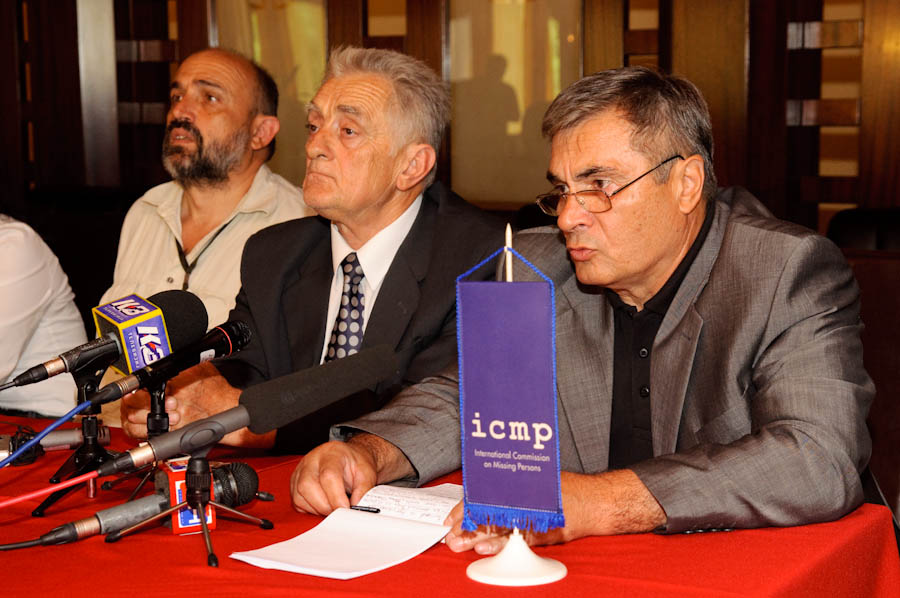
2 July 2009: The International Commission on Missing Persons (ICMP) held an information meeting in Banja Luka for representatives of the Republican Organization of Killed and Detained Soldiers and Missing Persons of Republika Srpska, Republican Board of Families of the Missing and the Union of Associations of Families of Missing and Captured Persons of Republika Srpska.
The purpose of this information meeting was for ICMP, the International Committee of the Red Cross (ICRC) and the Missing Persons Institute of Bosnia-Herzegovina (MPI) to provide the family associations of the missing with an update on progress to date.
The families received updates on ICMP’s assistance in the identification process, on the location, recovery and identification of mortal remains and on closing cases, as well as hearing from the Working Group on Resolving the Cases of Unidentified Mortal Remains in Memorial Ossuaries and Storage Rooms. The role of ICMP’s Banja Luka DNA laboratory was also explained: it forms an integral part of ICMP’s DNA laboratory system which has facilities in Tuzla, Sarajevo and Banja Luka.
«The Republika Srpska Court Medicine Institute has every faith and confidence in the scientific work of the International Commission on Missing Persons and its laboratories» said Željko Karan, head of the Republika Srpska Court Medicine Institute and added «Let me stress that we wish to continue cooperating constructively with this organization».
«ICMP is deeply committed to addressing every aspect of missing persons issue, another terrible legacy of the conflicts in this country. Our technical, and capacity building support is above all totally transparent and is aimed at helping families of the missing find their missing loved ones and to allow society in this region in dealing with its past.» said ICMP’s Director-General Ms.Kathryne Bomberger.
ICMP’s DNA-assisted human identification programs have lain at the heart of its considerable and ongoing successes in dealing with the question of some 40,000 missing persons in the former Yugoslavia, and since November 2001, ICMP has led the way in using DNA as a first step in the process of identification. In Bosnia alone it has identified 12,518 missing persons by matching DNA extracted from blood-samples of living relatives with DNA taken from bone-samples from mortal remains recovered from mass graves across the country.
In addition to its technical support, ICMP is the co-founder of the Missing Persons Institute of BiH. ICMP also contributes to transitional justice activities, provides legislative support and helps in the development of networks of civil society organizations which advocate for truth, justice, and for the rights of family members of missing persons.