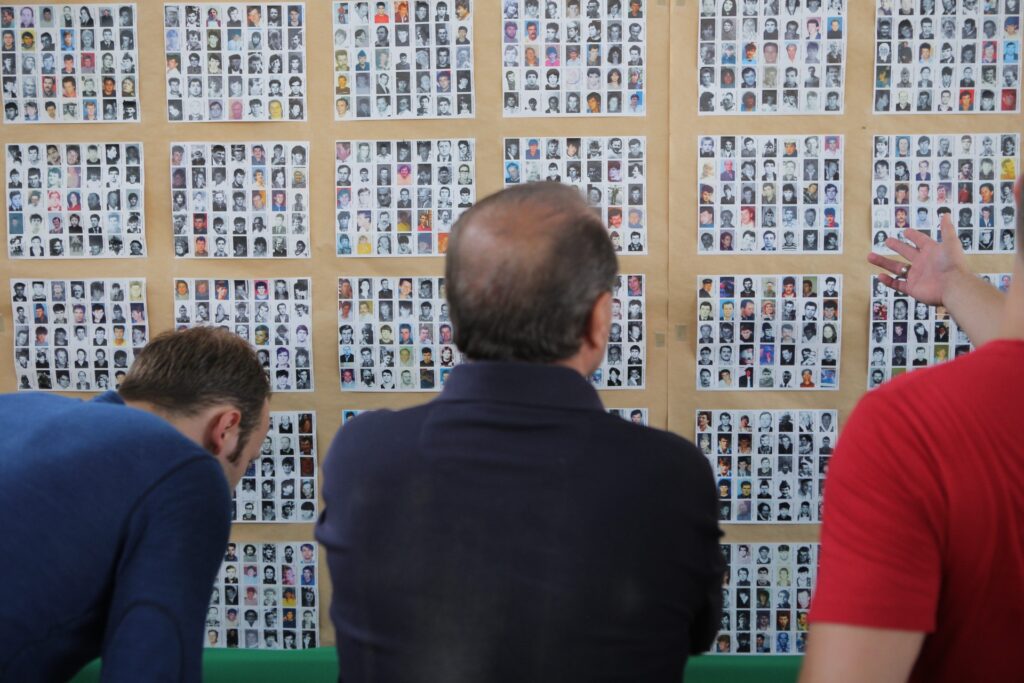
19 July 2014: The mortal remains of 284 people from Prijedor and the surrounding area will be laid to rest during a joint commemorative event in Kozarac, Prijedor, on Sunday. The victims, who went missing during the conflicts of the 1990s relevant to Bosnia and Herzegovina, were recovered and identified with the assistance of the International Commission on Missing Persons (ICMP). It is estimated that over 6,000 persons went missing from the Krajina region (about 20 municipalities in Northwest Bosnia and Herzegovina), primarily during 1992 and about 1,700 are still missing.
The majority of the victims who will be buried on Sunday were recovered in 2013 from a mass grave in Tomašica, near Prijedor in the Northwest part of Bosnia and Herzegovina. The Tomasica mass grave is one of the biggest and most complex conflict related sites found in Bosnia and Herzegovina to date.
From September to December 2013, ICMP experts assisted authorities in Bosnia, including the Missing Persons Institute and the Prosecutors office in excavating the mass grave site in Tomasica where over 400 cases of mortal remains were exhumed.
Non-Tomasica related victims will also be buried on Sunday in Prijedor. Through a purpose built mortuary facility in Sanski Most, known as Šejkovača, which was created in 2001, through an ICMP project known as the Krajina Identification Project (KIP), ICMP experts have been assisting local authorities in identifying through DNA the over 6,000 persons missing from the 1990s conflicts in the Krajina region.
Most of the persons who went missing in that area disappeared in 1992 and early efforts were made to identify victims by local authorities prior to the use of DNA. Consequently, there are a large number, approximately 300 sets of mortal remains that cannot be identified primarily due to earlier misidentifications. A local process has been underway to address these misidentifications with ICMP’s help. Some of the victims who will be buried tomorrow have now been accurately identified through this procedure.
“ICMP honors the memory of these victims and mourns with their families. ICMP has been helping the local authorities for years to resolve the difficult case of missing persons from the Prijedor region, as well as the rest of Bosnia and Herzegovina”, said ICMP Director General Kathryne Bomberger on this occasion, vowing for further support from ICMP to the exhumation and identification process.
Over 30,000 persons were considered missing in the Bosnia and Herzegovina following the armed conflicts in the 1990s, today over 70 percent have been accounted for. ICMP has assisted in identifying 14,600 persons missing from the conflicts relevant to Bosnia and Herzegovina through its human identification DNA laboratory system, while some additional 8,100 cases had been previously closed by traditional identification methods not involving DNA analysis. Many of these cases, including those in Sanski Most, are now undergoing a process of review by ICMP and local authorities.
ICMP endeavors to secure the co-operation of governments and other authorities in locating and identifying persons missing as a result of armed conflicts, human rights abuses, disasters, and other causes and to assist them in doing so. ICMP also supports the work of other organizations in their efforts, encourages public involvement in its activities and contributes to the development of appropriate expressions of commemoration and tribute to the missing.
ICMP is funded through voluntary grants, donations and contributions from participating governments.
ICMP’s assistance to Bosnia and Herzegovina in recovering and identifying the victims from the Tomašica mass grave was made possible with the support of the governments of the United Kingdom, Switzerland, Norway, Turkey, Sweden and the European Union.