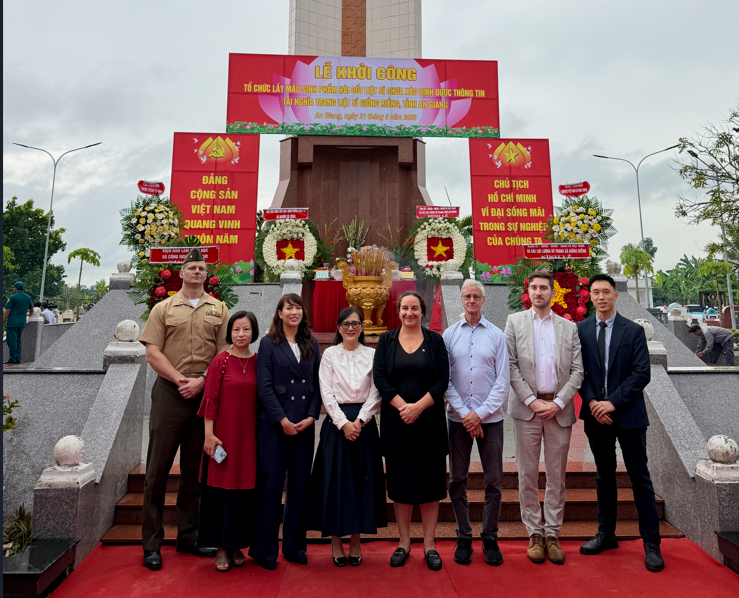
An Giang Province, Vietnam, 21 May 2026 – The International Commission on Missing Persons (ICMP), together with the Institute of Biology (IB) under the Vietnam Academy of Science and Technology (VAST), and in cooperation with the authorities of An Giang Province, has launched a large-scale exhumation and DNA identification effort at Giong Rieng Martyrs Cemetery in An Giang Province, Vietnam.
The initiative involves the exhumation of nearly 1,000 sets of unidentified human remains and the collection of postmortem samples for advanced DNA analysis. Excavation activities are expected to continue for approximately three weeks, after which all collected samples will be transferred to the laboratories of the Center for DNA Identification (CDI) under IB-VAST in Hanoi for processing and analysis.
The launch of the initiative coincides with Vietnam’s national “500 Days and Nights Campaign” to search for and identify missing persons ahead of the 80th anniversary of Vietnamese Martyrs Day on 27 July 2027.
The operation also marks the beginning of a pilot study on the large-scale implementation of next-generation sequencing (NGS)-based DNA analysis workflows jointly developed by ICMP and VAST. Through collaborative research conducted by ICMP and VAST scientists, the new methodology has successfully generated nuclear single nucleotide polymorphism (SNP) DNA profiles from highly degraded skeletal remains buried for decades in Vietnam’s tropical environment.
The pilot study forms part of an Official Development Assistance (ODA) project implemented at IB-VAST from March 2024 through March 2027, funded by the United States Government, with ICMP serving as the implementing partner.
„We have collaborated closely with international experts, especially the ICMP with support from the US State Department, to acquire, test, and develop NGS technology combined with SNP analysis. This is a significant breakthrough, opening up prospects for overcoming the limitations of traditional mitochondrial DNA identification methods,“ said Professor Dr. Chu Hoang Ha, Deputy Director of VAST, at the ceremony.
ICMP Director General Kathryne Bomberger said: „The work we are doing together with VAST and Vietnamese authorities with the support of the US State Department represents a major breakthrough in human identification technology. The application of these innovative DNA technologies can help Vietnam account for large numbers of unidentified persons, and the knowledge transfer that comes with this partnership can also help Vietnam become a leader in the field of advanced forensic genetics.“
Marialice Ariens, Political Officer at the U.S. Embassy in Vietnam, said: „For decades, Vietnam has assisted the United States in locating and verifying information about missing American servicemen. We are deeply grateful for that support. It is that gratitude that has brought us to where we are today. With funding from the U.S. Department of State, this pilot project utilizes next-generation DNA sequencing technology developed by ICMP and VAST to identify cases where existing technologies have been unable to do so.“
In parallel with the collection of postmortem samples at Giong Rieng Martyrs Cemetery, up to 5,000 family reference samples (FRS) will be collected with support from Vietnam’s Ministry of Public Security. These samples will be analyzed for SNP-based DNA matching using microarray technology that is also being optimized through the ICMP-VAST partnership.
If successful, the pilot project is expected to support the formal adoption by the Government of Vietnam of these advanced DNA identification methods as part of a national large-scale identification program. The initiative offers renewed hope to the families of hundreds of thousands of persons who remain missing from conflicts in Vietnam, including the Vietnam-American War (1955–1975).
About ICMP
ICMP is a treaty-based intergovernmental organization headquartered in The Hague, the Netherlands. Its mandate is to secure the cooperation of governments and others in locating missing persons resulting from conflict, human rights abuses, disasters, organized crime, irregular migration, and other causes, and to assist them in doing so. ICMP is among the global leaders in the development and application of next-generation sequencing technologies for the identification of missing persons.