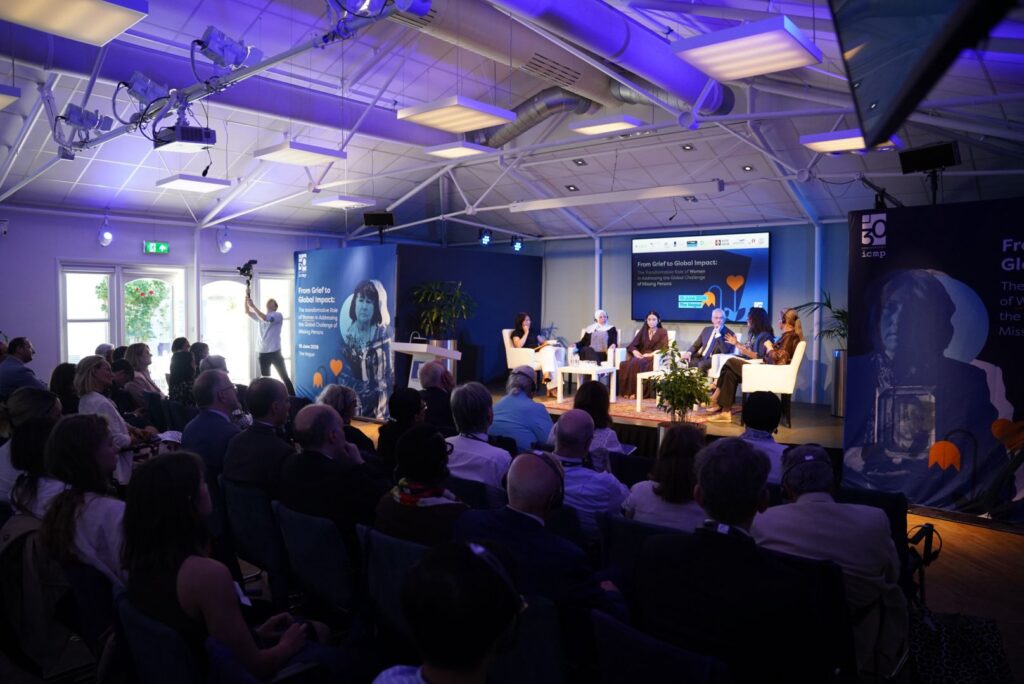
The Hague, 18 June 2026: Speakers at a roundtable held today in The Hague highlighted the transformative role of women in addressing the global challenge of missing persons. The roundtable, one of several events organized to mark the 30th anniversary of the International Commission on Missing Persons (ICMP), brought together human rights advocates, legal experts, survivors, and government representatives from around the world.
Discussion focused on the disproportionate burden borne by women in the context of missing persons and enforced disappearances, and the leadership roles that women have assumed in securing accountability and justice.
Addressing participants, Her Majesty Queen Noor, who has been an ICMP Commissioner since 2001, said that, since it was established at the G7 Summit in Lyon in June 1996, “ICMP has been guided by a principle that remains as relevant today as it was then: accounting for the missing is not only a humanitarian imperative – it is an investment in peace . . . it is about establishing truth, ensuring accountability, strengthening the rule of law, and restoring confidence in institutions. Without truth there can be no justice, and without justice lasting peace remains out of reach.”
Munira Subašić, a key figure in accounting for the men and boys who were murdered in the 1995 Srebrenica Massacre, said that “Alongside the search for the missing, we also fought for justice. The work of families of Srebrenica became inseparable from the historic proceedings of the International Criminal Tribunal for the former Yugoslavia (ICTY). We followed every indictment, every testimony, every judgment. We insisted that what had happened to our families be recognized in law as genocide, and that those responsible be held to account. Many of us, including myself and other mothers, gave testimony before the Tribunal. We carried photographs into courtrooms, we named our loved ones in legal proceedings, and we told the world what had been taken from us.”
Ms Subašić added that “ICMP became our partner along this path. Not as a substitute for our voice, but as a support to it. Not as someone who spoke for us, but as someone who helped ensure that truth could be established through science, law, and accountability.”
ICMP Director-General Kathryne Bomberger highlighted the need for “data-driven, gender-sensitive approaches that will shape and sustain global accountability,” and she warned that the global challenge of missing persons has increased in recent years due to conflict, climate change, and geopolitical instability. In this context, she reiterated “ICMP’s commitment to supporting families of the missing in the pursuit of truth and justice.”
Noting that “women are agents of activism”, Ms Bomberger added that women are also targeted because of their gender and “the gender perspective must be kept to the fore if we are to understand and address the global challenge of missing persons.”
H.E. Sahar Ghanem, Yemeni Ambassador to the Netherlands and Dean of the Diplomatic Corps, said the conflict in Yemen has resulted in a high number of missing and disappeared citizens. “The people of Yemen know, all too well, the deep and enduring pain that follows when a loved one vanishes without explanation. Families are left in a state of uncertainty that no passage of time can heal. These are not incidental consequences of conflict; they are matters of fundamental human rights that demand structured, lawful, and sustained responses.”
The roundtable was divided into two consecutive panels. The first panel, “From Grief to Justice and Global Impact”, moderated by Kimberly West, Specialist Prosecutor at the Kosovo Specialist Prosecutor’s Office (KSPO), brought together families of missing persons from Syria, Ukraine, and Iraq to examine how women affected by disappearances have transformed personal tragedy into global advocacy.
Lamia Bashar Taha, 2016 Sakharov Prize Laureate and survivor of ISIS captivity, spoke about the systematic targeting of Yazidi women and the search for thousands of missing Yazidis.
Yasmen Almashan, co-founder of the Caesar Families Association, highlighted the role of family associations in gathering evidence and advocating for accountability.
Nataliia Yepifanova, co-founder and head of Voyatsky Vyzvil, described how her organization documents war crimes and supports families of missing and captured Ukrainians.
Alan Tieger, Senior Prosecutor at the KSPO and former ICTY Senior Trial Attorney, reflected on how survivor testimony and forensic evidence have shaped landmark international prosecutions.
H.E. Antonia Urrejola, former President of the Inter-American Commission on Human Rights and former Minister of Foreign Affairs of Chile, spoke about transitional justice and the central role that women have played in securing truth and accountability following mass disappearances.
The second panel focused on issues identified in The Gender of Absence, the second volume of The Global Report on Missing Persons, a book-length publication that brings together the work of distinguished academics and practitioners in the global effort to account for missing persons. The Gender of Absence will be published by the University of California Press; the first Global Report was curated and published by ICMP in 2021.
The panel was moderated by Ms. Sirpa Rautio, Director of the EU Agency for Fundamental Rights, who highlighted, among other things, the intersection of civil society advocacy, legal innovation, and institutional development, and the importance of collaboration among states, international organizations, family associations, and civil society to achieve sustainable, rule-of-law-based solutions. She noted that this collaboration is consistent with EU foreign policy objectives.
Dr. Tâm T.T. Ngô, Senior Researcher at the NIOD Institute for War, Holocaust and Genocide Studies and Endowed Professor of Historical Anthropology of War Legacies at Erasmus University Rotterdam, presented findings on how communities memorialize and live with prolonged absence.
Dr. Sara Huston, Research Assistant Professor at Lurie Children’s Hospital of Chicago and Northwestern University and co-founder and President of DNA Bridge, discussed advances in DNA identification and the governance frameworks needed to ensure that these tools serve humanitarian ends.
Dr. Melanie Klinkner, Professor of International Law at Bournemouth University and leader of the five-year funded MaGPIE project on mass grave protection, investigation and engagement, addressed legal and forensic challenges in conflict settings and presented the Indicator Project, a collaboration between ICMP and Bournemouth University that aims progressively to present improved quantitative and qualitative global data on missing persons.
In the closing session, H.E. Stephen J. Rapp, former US Ambassador-at-Large for Global Criminal Justice and a member of ICMP’s Panel of Experts, reflected on 30 years of international efforts to account for missing persons and the imperative to continue building robust investigative and judicial frameworks.
During the roundtable several speakers referred to the Standing Capacity for Crisis Response (SCCR), an ICMP initiative to establish a ready, deployable, internationally coordinated capability that will help governments to respond to large-scale missing persons crises. The SCCR will be based on utilizing existing capacities in the most efficient and effective way.
Members of the ICMP Board of Commissioners participated in today’s Roundtable following the annual meeting of the Board, on 17 June.
ICMP’s 30th Anniversary Roundtable was supported by the Norwegian Agency for Development Cooperation (NORAD), the German Federal Foreign Office, and the Hague and Partners.
About ICMP
ICMP is a treaty-based international organization that seeks to ensure the cooperation of governments and others in locating missing persons from conflict, human rights abuses, disasters, organized crime, migration, and other causes, and to assist them in doing so.