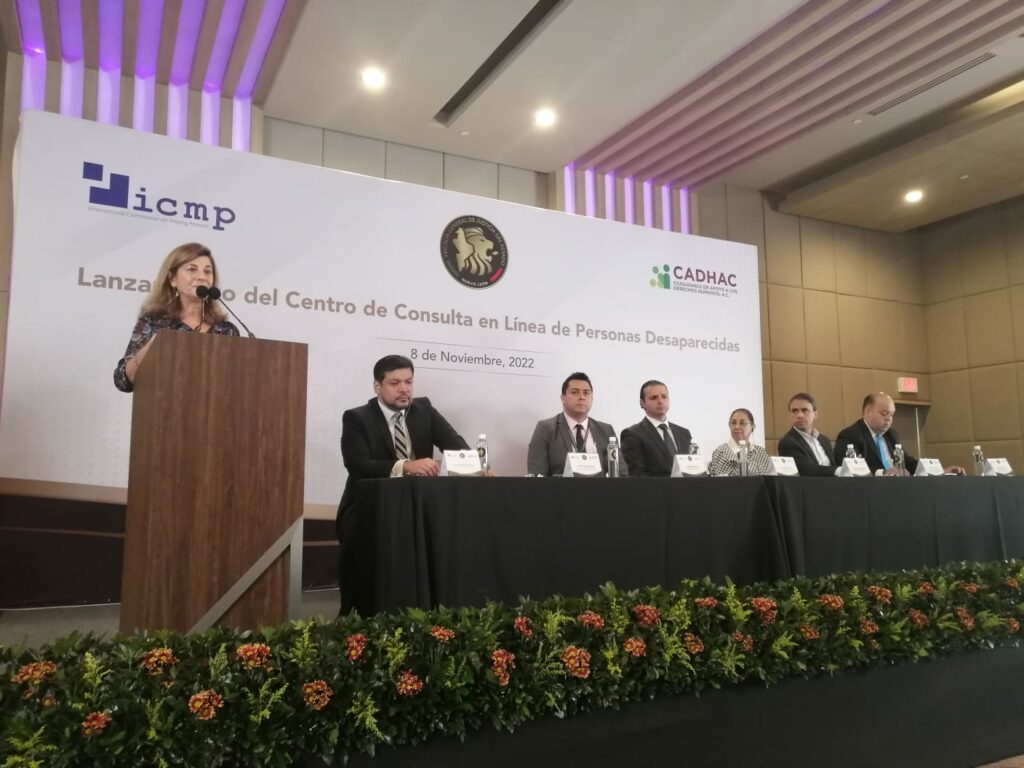
Monterrey, Nuevo Leon, 9 November 2022: The Office of the Prosecutor General in Nuevo Leon (FGJNL) and the International Commission on Missing Persons (ICMP) launched a major new initiative today that can significantly enhance efforts to account for persons who have gone missing.
Working with the FGJNL, ICMP has customized its Spanish-language Online Inquiry Center (OIC) for the state of Nuevo Leon, making it fully accessible for families of missing persons and others, allowing users to report missing persons cases, follow the progress of individual investigations, and add information about cases as it becomes available.
Today’s launch is one of the results of a program undertaken between 1 January 2019 and 31 July 2022, implemented by ICMP and Citizens in Support of Human Rights (CADHAC) in cooperation with the FGJNL. The program was generously supported by the United States Agency for International Development (USAID).
“Efforts to account for missing persons in Nuevo Leon, and in Mexico as a whole, have been hampered because information about cases is routinely held by different agencies in different databases, and this information is often not shared,” ICMP Director-General Kathryne Bomberger said at today’s launch. “Through this program, data stored in different registries has been checked, compared and consolidated and can now be accessed through ICMP’s Integrated Data Management System (iDMS). The portal to the iDMS, which can be accessed online from anywhere in Mexico and beyond, is the OIC.” Ms Bomberger added that the process that has now been created in Nuevo Leon “puts families of the missing fully in the driving seat.”
Pedro José Arce Jardón, acting head of the Prosecutor General’s Office, said the FGJNL had implemented more than 20 new missing persons protocols following ICMP recommendations. “Since the launch of the program this has enabled the Osseous Remains Laboratory (LARO), which was established under this initiative, to inspect 46,503 bone fragments. Of these, 230 selected by LARO for DNA testing have yielded 168 DNA profiles of victims. This 73-percent success rate is considerably higher than the figure achieved in the past. Although the new system has been directly responsible for just nine identifications so far, it is now fully operational and can deliver more identifications from now on.”
“Families must be at the center of the process,” said Sister Consuelo Morales, General Director CADHAC. “We must accompany and support them with expert skills and create a space where social and political actors do not compete but complement each other and contribute the best of themselves.”
During the four-year program, ICMP helped Nuevo Leon enhance its DNA identification capacities, creating a data-processing infrastructure for the registry of missing persons by implementing the iDMS, and improving governmental capacities to recover and identify human remains. Additionally, ICMP has provided operational support and technical assistance in the processing of human remains recovered from the “El Tubo” case in Hidalgo, Nuevo León.
ICMP analyzed 78,889 records of missing persons and through a specialized process of data analysis identified duplicate records and consolidated a unique registry containing 33,016 records. Of the records in the unique registry, 7,646 are confirmed as currently missing; the status of 10,350 is still to be confirmed; and 15,020 are closed cases (persons who have been found alive or identified by DNA). Just 25 percent of active cases have sufficient reference samples to make an identification.
ICMP delivered training to the Forensic Services (ICSP) on two new DNA extraction techniques that increase the possibility of obtaining a profile from small and difficult bone samples, as well as training in archeology and anthropology. ICMP is in the process of training FGJNL staff in the use of the iDMS.
About ICMP
ICMP is a treaty-based intergovernmental organization with Headquarters in The Hague, the Netherlands. Its mandate is to secure the cooperation of governments and others in locating missing persons from conflict, human rights abuses, disasters, organized crime, irregular migration and other causes and to assist them in doing so. It is the only international organization tasked exclusively to work on the issue of missing persons.[:es]Monterrey, Nuevo León, 9 de noviembre de 2022: La Fiscalía General de Justicia de Nuevo León (FGJNL) y la Comisión Internacional sobre Personas Desaparecidas (ICMP) lanzaron hoy una nueva e importante iniciativa que puede mejorar significativamente los esfuerzos para dar cuenta de las personas desaparecidas.
En colaboración con la FGJNL, ICMP ha adaptado su Centro de Consulta en Línea (OIC) en español para el Estado de Nuevo León, haciéndolo totalmente accesible para las familias de las personas desaparecidas y otras personas, permitiendo a los usuarios denunciar casos de personas desaparecidas, seguir el progreso de las investigaciones individuales y añadir información sobre los casos a medida que se encuentre disponible.
El lanzamiento de hoy es uno de los resultados del programa implementado por ICMP y Ciudadanos en Apoyo a los Derechos Humanos (CADHAC) en colaboración con la FGJNL, realizado entre el 1 de enero de 2019 y el 31 de julio de 2022. El programa contó con el generoso apoyo de la Agencia de los Estados Unidos para el Desarrollo Internacional (USAID).
„Los esfuerzos para dar cuenta de las personas desaparecidas en Nuevo León, y en México, se han visto obstaculizados porque la información sobre los casos se mantiene rutinariamente por diferentes agencias en diferentes bases de datos, y esta información a menudo no se comparte“, dijo la Directora General de ICMP, Kathryne Bomberger, en el lanzamiento de hoy. „A través de este programa, los datos almacenados en diferentes registros se han comprobado, comparado y consolidado y ahora se puede acceder a ellos a través del Sistema Integrado de Gestión de Datos (iDMS) de ICMP. El portal del iDMS, al que se puede acceder en línea desde cualquier lugar de México y más allá, es el OIC“. La Sra. Bomberger añadió que el proceso que se ha creado ahora en Nuevo León „pone a las familias de los desaparecidos totalmente al mando“.
Pedro José Arce Jardón, titular interino de la Fiscalía General, dijo que la FGJNL ha implementado más de 20 nuevos protocolos de personas desaparecidas siguiendo las recomendaciones de ICMP. „Desde la puesta en marcha del programa, esto ha permitido que el Laboratorio de Análisis de Restos Óseos (LARO), creado en el marco de esta iniciativa, inspeccione 46.503 fragmentos óseos. De ellos, 230 seleccionados por el LARO para la realización de pruebas de ADN han dado lugar a 168 perfiles de ADN de las víctimas. Esta tasa de éxito del 73% es considerablemente superior a la alcanzada en el pasado. Aunque el nuevo sistema ha sido directamente responsable de sólo nueve identificaciones hasta el momento, ya es plenamente operativo y puede ofrecer más identificaciones a partir de ahora.“
„Las familias deben estar en el centro del proceso“, dijo la hermana Consuelo Morales, Directora General de CADHAC. „Debemos acompañarlas y apoyarlas con competencias expertas y crear un espacio donde los actores sociales y políticos no compitan sino que se complementen y aporten lo mejor de sí mismos.“
Durante el programa de cuatro años, ICMP ayudó a Nuevo León a mejorar sus capacidades de identificación de ADN, creando una infraestructura de procesamiento de datos para el registro de personas desaparecidas mediante la implementación del iDMS, y mejorando las capacidades gubernamentales para recuperar e identificar restos humanos. Además, ICMP ha proporcionado apoyo operativo y asistencia técnica en el procesamiento de los restos humanos recuperados del caso „El Tubo“ en Hidalgo, Nuevo León.
ICMP analizó 78.889 registros de personas desaparecidas y, mediante un proceso especializado de análisis de datos, identificó los registros duplicados y consolidó un registro único que contiene 33.016 registros. De los registros en el registro único, 7.646 están confirmados como actualmente desaparecidos; el estado de 10.350 está aún por confirmar; y 15.020 son casos cerrados (personas que han sido encontradas vivas o identificadas por ADN). Sólo el 25% de los casos activos tienen suficientes muestras de referencia para realizar una identificación.
ICMP impartió formación al Instituto de Criminalística y Servicios Periciales (ICSP) sobre dos nuevas técnicas de extracción de ADN que aumentan la posibilidad de obtener un perfil a partir de muestras óseas pequeñas y difíciles, así como formación en arqueología y antropología. ICMP está en proceso de formar al personal de la FGJNL en el uso del iDMS.
Acerca de ICMP
ICMP es una organización intergubernamental basada en un tratado con sede en La Haya, Países Bajos. Su mandato consiste en garantizar la cooperación de los gobiernos y otras entidades en la localización de personas desaparecidas a causa de conflictos, violaciones de los derechos humanos, catástrofes, delincuencia organizada, migración irregular y otras causas, así como en prestarles asistencia. Es la única organización internacional encargada exclusivamente de trabajar en la cuestión de las personas desaparecidas.