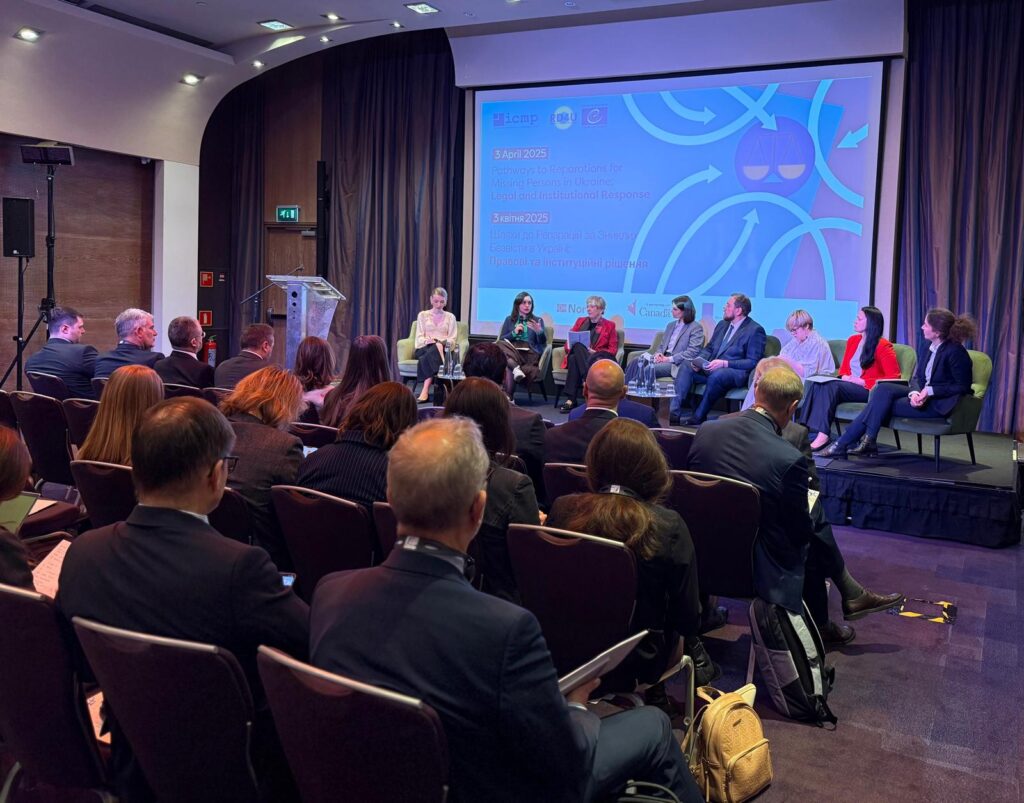
The Hague, 3 April 2025: Families whose relatives have disappeared as a result of the Russian invasion of Ukraine have the right to truth, justice and compensation, speakers at a roundtable in The Hague said today, and they stressed that while the authorities have taken important steps to assist families of the missing, further steps can be taken, even in the present challenging circumstances.
Government and civil society representatives from Ukraine, as well as international experts, took part in today’s roundtable, organized by the International Commission on Missing Persons (ICMP) and Register of Damage for Ukraine (RD4U).
The Russian invasion has resulted in tens of thousands of missing persons, leaving families to face multiple administrative and practical challenges in addition to the trauma of not knowing the fate of a loved one. Today’s meeting focused on legal provisions that can help such families. One of these is Category A2.2, a claim category launched by RD4U on 12 March, that enables families of the missing to claim inheritance and custody rights.
Category A2.2 is “a significant step forward,” ICMP Director-General Kathryne Bomberger told roundtable participants. She stressed that “victims have a fundamental right to reparation, to redress violations of human rights through a range of material and symbolic benefits. Reparations must be adequate, effective, prompt, and proportionate.”
The right to reparation under international law extends to those affected by the disappearance of their loved ones,” said RD4U Executive Director Markiyan Kliuchkovskyi. “This is why the work of the Register of Damage for Ukraine and the creation of the claims category for missing immediate family members is so vital. It fills a critical gap in the reparations framework, ensuring that the distinct experience of families of the missing is recognized and addressed.”
Artur Dobroserdov, Ukraine’s Commissioner for Missing Persons, told participants at the roundtable that the rights of missing persons and their families “occupy a special place among the challenges related to the search for and identification of missing persons”. He said his Office is already focused on questions regarding Death Certificates and the legal basis for establishing guardianship over the property of persons missing in special circumstances. “The issue of reparations for missing persons is a logical continuation of efforts to ensure the rights of families of the missing to justice.”
“Many people spend years, and their life savings, searching fruitlessly for their husbands, wives, children or parents,” said Kateryna Rashevska, Legal Expert at the Regional Center for Human Rights. She noted that “this can be financially crippling as well as emotionally traumatic”, and that families who are living with the disappearance of a loved one “require assistance on many levels”. She said responsibility for enacting and implementing relevant provisions of international law rests mainly with the domestic authorities, though international organizations such as ICMP also play an important role.
An initiative that was discussed today is the possibility of introducing “Certificates of Absence”, which would enable families to access certain rights even when a death certificate has not been issued. Certificates of Absence have proved to be useful in other countries dealing with large numbers of missing persons. Several speakers suggested that such Certificates should be introduced as a matter of urgency.
ICMP’s Ukraine Program is supported by the governments of the Netherlands, Canada, Germany, Norway, and the United States.
About ICMP
ICMP is a treaty-based intergovernmental organization with Headquarters in The Hague, the Netherlands. Its mandate is to secure the co-operation of governments and other authorities in locating persons missing as a result of conflicts, human rights abuses, disasters, organized violence and other causes and to assist them in doing so.
About RD4U
The Register of Damage for Ukraine, established under the auspices of the Council of Europe, serves as an essential step toward an international compensation mechanism. Currently, claims can be submitted in nine categories:
- A1.1 (involuntary internal displacement)
- A2.1 (death of an immediate family member)
- A2.2 (missing immediate family member)
- A2.3 (serious personal injury)
- A2.4 (sexual violence)
- A2.5 (torture, inhuman or degrading treatment or punishment)
- A2.6 (deprivation of liberty)
- A2.7 (forced labour or service)
- A3.1 (damage or destruction of residential property)
Additional categories of claims will be launched in due course.
The Register continues to encourage all eligible individuals to submit their claims. Information on claims categories, eligibility criteria, and submission procedures is available on the Register’s website.