12 February 2021 – At the end of the mourning period for 104 Yezidi victims who were buried last week, Alexander Hug, the head of the International Commission on Missing Persons (ICMP)’s Iraq program, emphasized that Iraq’s efforts to account for all its missing persons must continue with urgency.
“I extend my deepest condolences to the families of the victims, and I offer my sympathies not only to them but to all of the many families in Iraq who are missing relatives from a legacy of conflict and human rights abuses, starting with the regime of Saddam Hussein and including Da’esh crimes,” Hug said. “It is essential that Iraqi authorities prioritize this issue and build a cogent strategy to find all missing persons and secure the rights of all survivors, who are primarily women. By doing so, Iraq will make a long-term investment in peace and stability.”
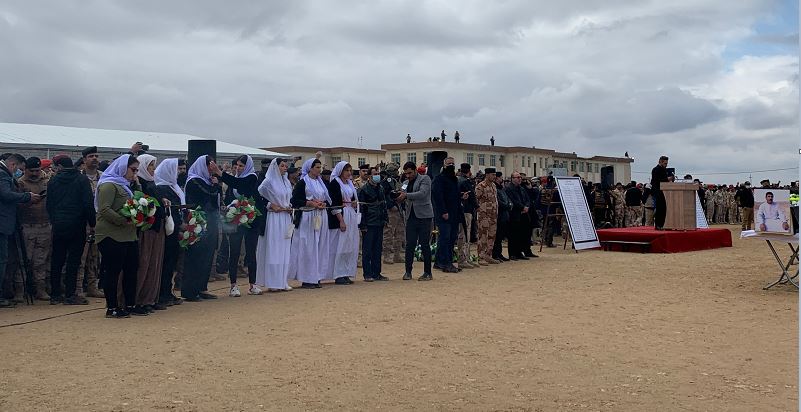
The mourning period for the victims, laid to rest on 6 February following official ceremonies in Baghdad and Sinjar, ended today. They had been found in mass graves in Kocho village and elsewhere in Sinjar district during excavations conducted by Iraqi authorities with support from ICMP and other partners. The victims had been missing since Da’esh attacked the area in 2014.
Iraqi authorities estimate that between 250,000 and 1 million persons are missing in the country. They have disappeared as a result of decades of conflict and human rights abuse, including atrocities committed during the Ba’ath Party regime, wars and atrocities committed by Da’esh. Iraqis who have left the country also are missing, including victims who have died while crossing the Mediterranean Sea.
ICMP has supported the Iraqi government’s efforts to fulfil its responsibilities to victims and their families since 2008, including by training scientists in advanced DNA identification procedures, supporting excavations of mass graves and assisting civil society and families of the missing. ICMP works with the authorities to assist in efforts to establish a central body responsible for accounting for all missing persons and a Central Record of Missing Persons, elements that are key to successful missing persons programs.
In relation to the recently buried Yezidi victims, ICMP also facilitated dialogue among the government, civil society and family members. In addition, ICMP supported the national authorities in campaigns during which family members of the victims provided genetic reference samples for DNA testing and matching. DNA extracted from family reference samples were compared with DNA extracted from the remains, laying the basis for the process to determine the victims’ identities.
A few days ahead of the funeral ceremony, ICMP held a workshop on the role of families in the process to account for missing persons. Representatives from the Iraqi authorities answered questions during the online event.
ICMP’s work in Iraq is financed by Germany, the Netherlands and the United States Department of State.
About ICMP
ICMP is a treaty-based intergovernmental organization with Headquarters in The Hague, the Netherlands. Its mandate is to secure the cooperation of governments and others in locating missing persons from conflict, human rights abuses, disasters, organized crime, irregular migration and other causes and to assist them in doing so. It is the only international organization tasked exclusively to work on the issue of missing persons.