The Hague, 19 December 2019: As part of its support to Iraqi authorities in developing capacity to handle missing persons cases, the International Commission on Missing Persons (ICMP) this week trained the leaders of the DNA lab at Iraq’s Medico-Legal Directorate (MLD).
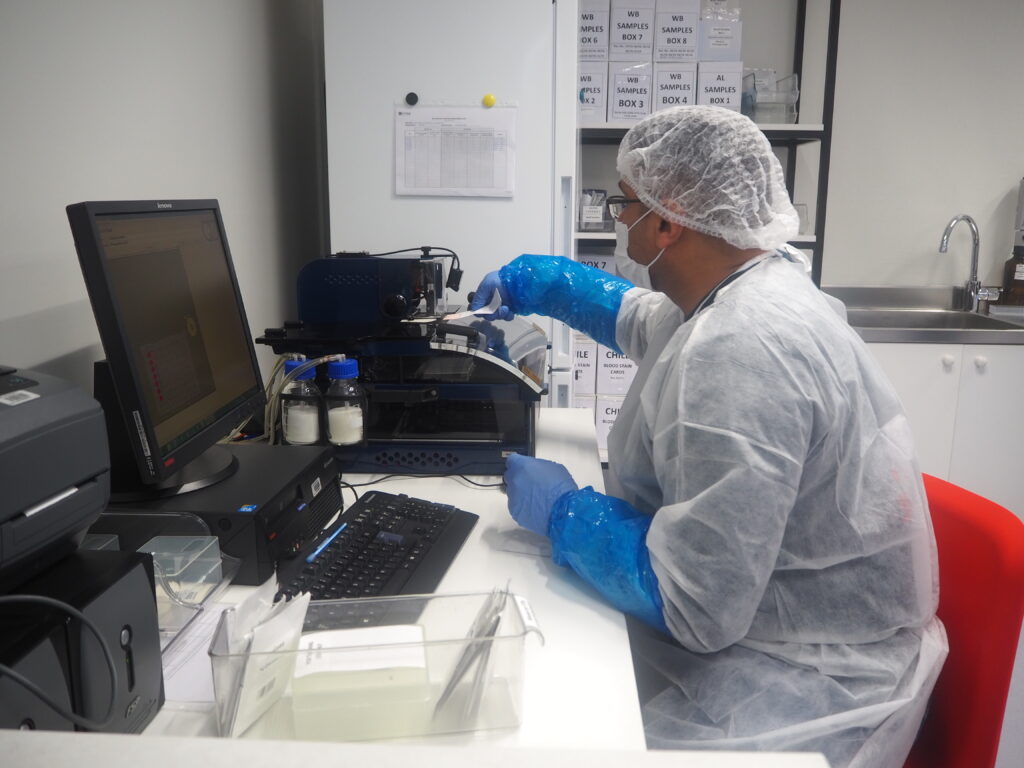
The head of the lab, Mr. Mohammed Mashni Farhan, and deputy lab head Dr. Salim Shabaan Mahmood, were trained on using an automated puncher that will enable their lab to more than double the number of samples it processes a day. The ICMP, recently donated such a puncher to MLD, one of the Iraq’s main national agencies that are responsible for addressing the missing persons issue.
His Excellency, Hisham al Alawi, Ambassador of Iraq, staff from the Iraqi Embassy in the Netherlands, ICMP Director-General Kathryne Bomberger and the ICMP Director of Science and Technology, Thomas Parsons, took part in the opening session of the training, which was supported by the European Union. The training also included theoretical and practical sessions at the ICMP’s DNA laboratory.
The training focused on topics such as reference sample processing, advanced technologies and approaches to DNA identification, data processing and protection. It also included a presentation on the latest developments in the MLD laboratory.
To extract DNA from cards on which blood or cheek swabs have been collected from relatives of missing persons, DNA scientists use a puncher to create a small disk for further processing. By using the new automated puncher, the MLD lab will be able to process more than 200 and sometimes even 400 samples a day, up from the 100 a day that were possible when using a manual puncher, said Mr. Mashni Farhan.
“The training and the new equipment will contribute to faster processing of missing persons reference samples,” he said. “This is very beneficial as Iraq has a huge number of missing persons and a huge number of reference samples.”
Dr. Shabaan Mahmood added that the combination of lab exercises with briefings enabled effective learning. “We learned a lot of new techniques and approaches. This increased our technical capacities – we look forward to applying these at the MLD laboratory,” he said.
Iraq has hundreds of thousands of missing persons cases, including those missing from the Saddam Hussein regime. ICMP has worked with the authorities in Iraq since 2003, helping survivors to access their rights and helping the authorities to account for all missing persons, regardless of their sectarian or national background, or the period of time in which they disappeared.
ICMP is a treaty-based international organization with Headquarters in The Hague, the Netherlands. Its mandate is to secure the cooperation of governments and others in locating missing persons from conflict, human rights abuses, disasters, organized crime, irregular migration and other causes and to assist them in doing so. It is the only international organization tasked exclusively to work on the issue of missing persons.
ICMP’s program in Iraq is funded by the European Union’s Service for Foreign Policy Instruments.